


(The Epoch Times)—As states gear up for highly consequential elections this fall, one of the most critical factors in the United States is the rise of mass mail-in voting.
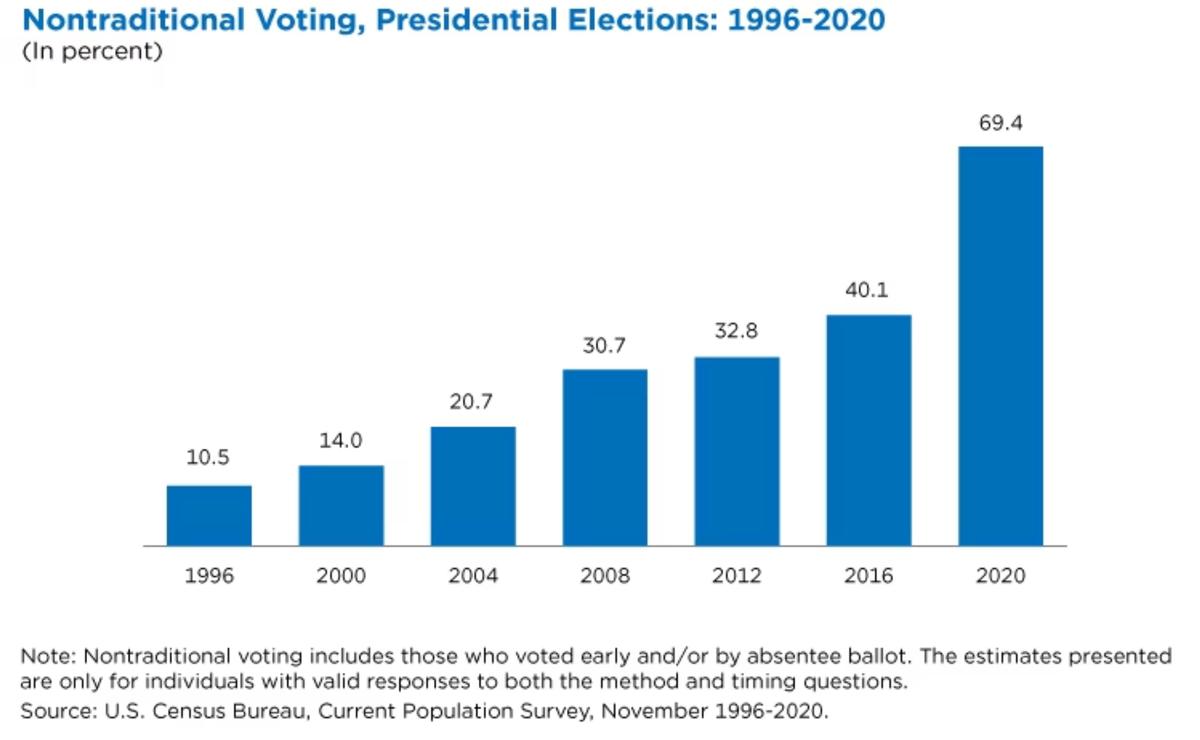
According to the Census Bureau, 43 percent of American voters cast ballots by mail in 2020, double the 21 percent who did so in 2016.
While 2020 was an exceptional year because of the government’s response to the COVID-19 virus, the United States is nonetheless experiencing a longer-term transition to an absentee ballot system from an in-person system. Currently, California, Colorado, Hawaii, Nevada, Oregon, Utah, Vermont, Washington, and the District of Columbia have “mostly mail voting” systems, according to an analysis by the National Conference of State Legislatures (NCSL).
And while the 2020 election saw record levels of voter turnout, the shift away from traditional voting methods also coincides with a decline in trust in America’s electoral system. An October 2023 poll by the Public Affairs Council, found that only 37 percent of Americans believe the 2024 elections will be both “honest and open,” while 43 percent expressed “serious doubts” about election integrity.
This loss of trust raises the question of whether the problem stems from losing candidates charging that the elections were stolen from them, or from America transitioning to a system that prioritizes convenience from one that prioritized integrity.
Many pundits claim there is no tradeoff between the two and government officials, notably the Cybersecurity and Infrastructure Security Agency, called the 2020 election “the most secure in American history.”
However,, a large number of Americans, particularly Republican and Independent voters, remain unconvinced.
The NCSL cautions that “if a voter is marking a ballot at home, and not in the presence of election officials, there may be more opportunity for coercion by family members or others.”
JD’s manually curated links for God-fearing MAGA patriots
According to a recent NCSL study, 28 states, including the key swing states of Arizona, Georgia, Pennsylvania, Michigan, and Wisconsin, currently offer “no-excuse” absentee voting, which means that any voter can request and cast an absentee ballot without offering a reason.
In addition, California, Colorado, Hawaii, Nevada, Oregon, Utah, Vermont, and Washington, D.C., automatically mail absentee ballots to all voters.
In the remaining 15 states, voters must provide an acceptable excuse (such as illness or disability, or being overseas on Election Day) to qualify for an absentee ballot.
The Heritage Foundation, a conservative think tank that keeps a running tally of proven cases of voter fraud, has documented more than 1,500 cases to date and 1,276 criminal convictions.
“Each and every one of the cases in this database represents an instance in which a public official, usually a prosecutor, thought it serious enough to act upon it,” the report states. “And each and every one ended in a finding that the individual had engaged in wrongdoing in connection with an election hoping to affect its outcome—or that the results of an election were sufficiently in question and had to be overturned.”
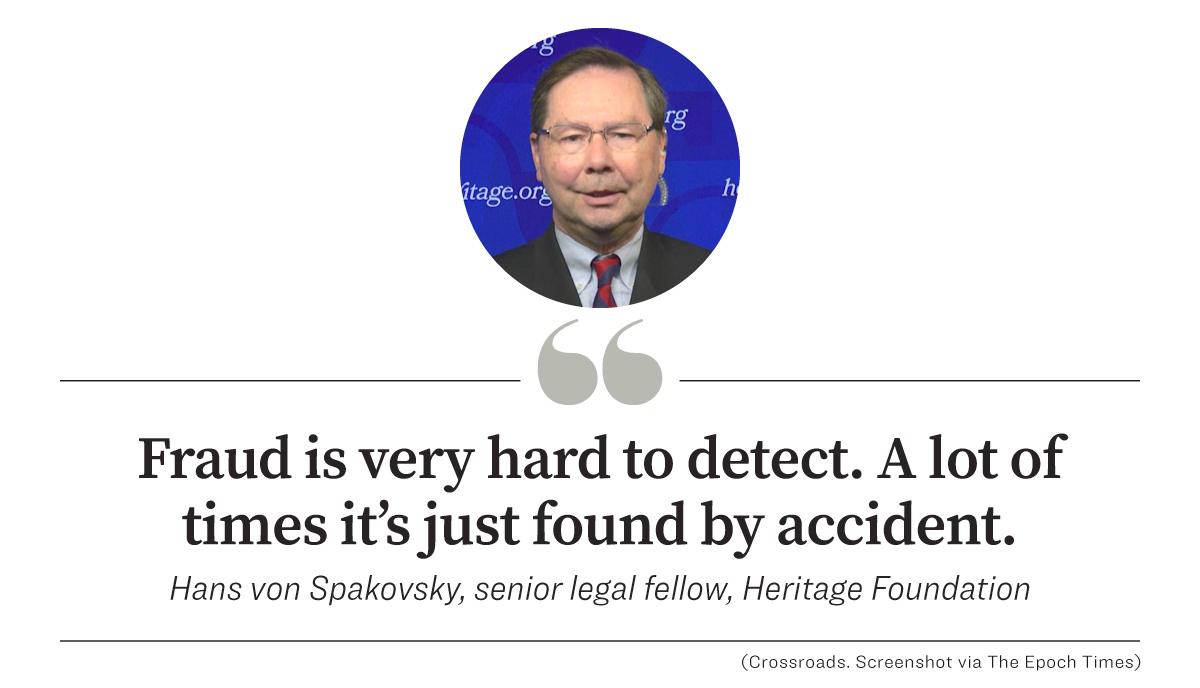
According to Hans von Spakovsky, senior legal fellow at the Heritage Foundation, the numbers cited in the report are probably an understatement.
“The thing about these 1,500 cases is that they’re clearly just the tip of the iceberg because fraud is very hard to detect,” he told The Epoch Times. “A lot of times it’s just found by accident, particularly in a state like New York or California where there’s no voter ID requirement at all.”
Many of these cases cited in the report involved the fraudulent use of absentee ballots. In the case of one Michigan resident who was convicted of voter fraud, “an employee at an assisted living facility, completed roughly two dozen absentee voter applications, forging individual signatures of residents.”
However, the left-leaning Brennan Center for Justice, an affiliate of New York University, criticized what it said was the “myth of voter fraud.”
“Politicians at all levels of government have repeatedly, and falsely, claimed the 2016, 2018, and 2020 elections were marred by large numbers of people voting illegally,” the institute said in a report. “However, extensive research reveals that fraud is very rare, voter impersonation is virtually nonexistent, and many instances of alleged fraud are, in fact, mistakes by voters or administrators.
“The same is true for mail ballots, which are secure and essential to holding a safe election amid the coronavirus pandemic,” its report states.
In the manic weeks following the 2020 election, data analytics expert Ken Block, president of Simpatico Software Systems, was hired by the Trump campaign to data-mine for voter fraud in the key states of Georgia, Pennsylvania, Arizona, Nevada, Michigan, and Wisconsin, and find “factual, hard evidence that can underpin successful legal challenges.”
“It started with assessing the deceased voters and duplicate voters,” Mr. Block told The Epoch Times. “We looked at every single mail-in ballot cast in the swing states, looking for deceased voters.
”We found, in terms of actual deceased voters that we could confirm through data, a couple of dozen.”
Mr. Block said he found a small number of people who voted twice, typically wealthy individuals who had two residences, but the cases of detected fraud were not nearly enough to sway the election. He was also asked by the Trump campaign to investigate various “hearsay claims” of voter fraud.
“We looked at every single voter fraud claim, and I was able to show with evidence and proof why it was flawed, or just completely wrong in the first place, and those findings were accepted by [President Trump’s] lawyers,” he said. “I think it’s crucially important that everybody understands how hard we looked and how important it was, from a legal standpoint, that the claims of fraud that I evaluated were looked at as hard, if not harder than the defense attorneys who would be fending off these lawsuits.”
And yet, despite all efforts to assure the public that elections are sound, many Americans continue to suspect that something is amiss.
While some instances of voter fraud may be detectable in data and audits, others, such as whether voters are noncitizens, or engaging in ballot harvesting, or illicitly filling out ballots on behalf of others, are more difficult to detect unless witnessed in person or caught on camera.

A particular issue with mail-in ballots is the proliferation of ballot drop-off boxes since 2020, few of which are monitored.
According to Mollie Hemingway, editor-in-chief of The Federalist, and others who analyzed the 2020 election, the funding and locations of many ballot drop boxes in 2020 was directed by an organization called the Center for Tech and Civic Life, backed by hundreds of millions of dollars from Facebook founder Mark Zuckerberg.
Ms. Hemingway argued in her book, “Rigged,” that the donations from Mr. Zuckerberg, called “Zuck Bucks,” were partisan and focused on swing states.
The influence of private money in state electoral systems has only heightened the suspicions of many Americans.
A 2021 report from the Massachusetts Institute of Technology (MIT) Election Lab states that “even many scholars who argue that fraud is generally rare agree that fraud with VBM [vote-by-mail] voting seems to be more frequent than with in-person voting.
“There are two major features of VBM that raise these concerns,” the report states. “First, the ballot is cast outside the public eye, and thus the opportunities for coercion and voter impersonation are greater.

“Second, the transmission path for VBM ballots is not as secure as traditional in-person ballots. These concerns relate both to ballots being intercepted and ballots being requested without the voter’s permission.”
The report cites, among others, the case of a campaign manager in a North Carolina congressional race who collected empty mail-in ballots and then filled them in for his own candidate. Ultimately, that led to the election being overturned.
A recent study by the Heartland Institute infers from a voter survey that mail-in ballot fraud likely occurred in large enough numbers to have swayed the 2020 presidential election.
The study found that, in swing states, mail-in votes in 2020 heavily favored candidate Joe Biden, typically outnumbering mail-in votes for President Donald Trump by 2 to 1. Based on a 2023 survey of 1,000 voters conducted jointly with Rasmussen Reports, Heartland found that 28 percent of respondents said that they had voted in a way that could be illegal, including filling out ballots for others, forging signatures, or voting in states where they weren’t permanent residents.
By removing 28 percent of mail-in ballots from both candidates in the swing states of Arizona, Georgia, Michigan, Nevada, Pennsylvania, and Wisconsin, Heartland calculated that Trump would have won the Electoral College, 311–227.
Critics of this study have countered that the framing of the questions may have confused those being surveyed. Filling out ballots for others, for example in the case of a blind or disabled family member, isn’t always illegal.
Critics also questioned whether respondents to the survey may have confused request forms to receive mail-in ballots—to which the voter fraud issues don’t apply—with the actual ballots themselves.
To allow for error, however, Heartland reduced the number of disqualified votes to 3 percent from 28 percent and calculated that President Trump would still have won the Electoral College, 279–259.
“It’s not worth re-litigating the 2020 election,” Jack McPherrin, a research editor at the Heartland Institute and one of the study’s authors, told The Epoch Times. But he says that claiming the 2020 election was the most secure in U.S. history is “a pretty ridiculous assertion.”
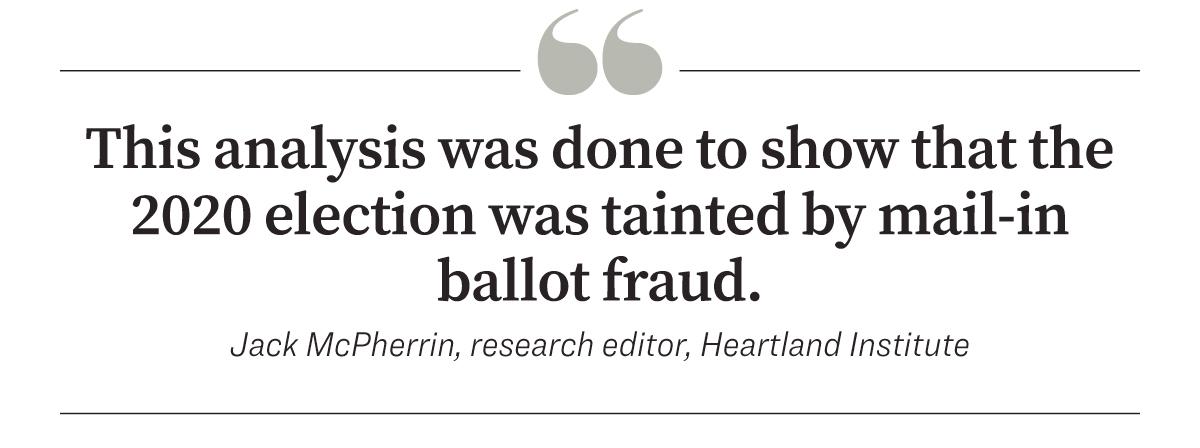
“This analysis was not done to say Trump is our rightful president,” Mr. McPherrin said. “This analysis was done to show that the 2020 election was tainted by mail-in ballot fraud so that we can fix it moving forward.
“It just provides a great avenue for fraud because there are so few restrictions and policies in place to prevent it,” he said. “Those policies were intentionally relaxed in 2020 in many states, and that opened the floodgates for fraud to occur.”
Asked how he could reconcile his findings with investigations that indicated voter fraud was exceedingly rare, he said that “mail-in ballot fraud is extremely difficult to prove.”
One aspect of mass mail-in voting that causes particular concern is ballot harvesting, or the process of private citizens or organizations collecting and submitting ballots on behalf of others, outside of the supervision of election officials.
According to a 2022 report authored by Mr. von Spakovsky, the potential for voter fraud “is made worse in the many states like California that allow vote trafficking, which proponents of mail-in voting call ‘vote harvesting’ because that sounds better.”
Every state allows absentee ballots to be mailed back or delivered personally to election officials by voters, their immediate family members, or a designated caregiver, he notes.
“But vote-trafficking states allow any third-party stranger to go to voters’ homes to pick up and deliver their ballot,” the report states.
“In other words, these states give political actors with a stake in the outcome of the election the ability to handle a very valuable commodity—the ballots that can ensure the victory (or defeat) … of the candidates who they work for and support, giving them the opportunity to complete, alter, or simply fail to deliver those ballots.”
Advocates of mail-in voting counter that states that have all-mail elections typically require voters to sign the envelope in which the ballot is mailed and then match it with the signature in the state’s voter rolls. In addition, they say, many counties place bar codes on ballot envelopes that can be tracked by the U.S. Postal Service.

How bar codes would track votes in the case of ballot drop boxes is unclear, however. And according to the NCSL, only 31 states verify signatures on mail-in ballots, and 10 states and Washington, D.C., verify that a mail-in ballot envelope has been signed but don’t conduct signature verification.
With the November election fast approaching, what can be done to restore trust among American voters so that, whoever wins, the result is accepted by both parties as legitimate and fair?
Mr. von Spakovsky has proposed systematic election audits as one solution. Typically, he said, post-election analyses amount to hand recounts of ballots, but don’t verify if all ballots cast were legitimate.
He proposes pre-election audits of voter rolls to ensure that all registered voters are eligible to vote. He also proposes, among other things, equipment audits to ensure voting machines are accurate, procedure audits to ensure that election laws were followed, and chain-of-custody audits for ballots.
While it may be impractical to conduct full audits of every voting district, Mr. von Spakovsky proposed a model adopted in Texas where a minimum number of randomly selected districts are audited each election cycle, and additional audits conducted where credible cases of malfeasance have been charged.
Election audits have received some pushback from Democrats, Mr. von Spakovsky said. The Biden administration initially sued to block the process of post-election audits, claiming that it was voter intimidation and a violation of the Voting Rights Act.
“I think that was a purely partisan decision,” he said. To date, the Justice Department hasn’t pursued this claim further.
Many also propose tightening up ID requirements, despite the objections of organizations such as the American Civil Liberties Union and the Brennan Center, which consider it voter suppression.
“We strongly recommend that a state not only have ID requirements for in-person voting, but that they also have it for absentee balloting,” Mr. von Spakovsky said. “While a family member might have the ID of someone that they’re voting for in their family, it might make it more difficult for strangers to be able to do that.”
Currently, seven states require the signature of a witness on absentee ballots, in addition to the voter’s signature, and three states—Mississippi, Missouri, and Oklahoma—require the absentee ballot envelope to be notarized. In Arkansas, a copy of the voter’s ID must be returned with the absentee/mail ballot.
Proof of U.S. citizenship is another area where illegal voting is hard to detect, as there are no nationwide databases of citizenship. Audits to confirm citizenship sometimes rely on purchases of data banks from credit agencies, but that would not include those who do not have loans or credit cards, including many students.
This is complicated by the fact that many states provide driver licenses to noncitizens, and some states allow noncitizens to vote in local elections.
In addition, a 2013 Supreme Court ruling in the case of Arizona v. Intertribal Council of Arizona barred states from requiring proof of U.S. citizenship in federal elections. According to the decision, states can “require only that an applicant aver, under penalty of perjury, that he is a citizen.”
According to Mr. Block, another challenge that the electoral system faces is the sheer variety of voting regulations, not only among states, but among counties as well. There are more than 5,000 different voting jurisdictions across the United States, he said.
“We have a basic framework problem in the way that we’re organized and the infrastructure that we have,” he said. “It lacks the basic things we need for integrity in terms of ensuring people can’t vote twice, ensuring that deceased voters are efficiently removed from voter rolls, etc.”
Given that there is now less than a year before the election begins, analysts say that the 2024 election will likely proceed under election rules and systems that are similar to those in 2020, despite the absence of a pandemic. And if the election is close, as many expect it will be, many will continue to mistrust the outcome.
Mr. McPherrin argues the United States is capable of going back to a system where the majority of people, on election day present ID, vote in person, and the country knows the results by the next day.
“It’s absurd to think we can’t do that,” he said. “We’ve done that many times in the past and we can continue to do that moving forward; we just need to revert back to the systems that we had in place in 2016, 2012, and 2008.

“What can be more important than ensuring election security in a democratic republic?” Mr. McPherrin said. “I can’t think of a single other thing that’s more important because it’s the foundation of our entire constitutional republic, and without secure elections, we will not have a functioning democratic republic for much longer.”
Bypass Big Tech Censors
Two Storms, One Harvest

Every food crisis in living memory has been a one-shock event. The 2008 price spike was a commodity bubble. The 2020 shortages were a logistics failure. The 2022 grain scare was a war on one exporter’s ports. Each time, the system bent, adjusted, and recovered, and each time the experts assured us afterward that global markets are simply too big and too diversified to fail.
What nobody in Washington seems eager to discuss is that 2026 is shaping up to be something the modern food system has never actually faced. Two independent shocks, one climatic and one geopolitical, are converging on the same harvest cycle at the same time. Not sequentially. Simultaneously.
Start with the weather. The Pacific Ocean is currently building toward what forecasters now openly call a record event. NOAA’s Climate Prediction Center puts the odds of at least a strong El Niño near 88 percent, with roughly two in three odds it reaches “very strong” status, the tier reserved for perhaps three or four events in the entire satellite era. Every major global model now projects a median peak in Super El Niño territory, and most of them project it exceeding the 2015-16 event, which until now held the modern record. Sea surface anomalies were already brushing the super threshold in mid-July, months before these events normally peak. The atmosphere has already shifted into El Niño mode, and the event is forecast to crest in late fall and early winter.
This is not about “climate change.” It’s about the standard cycles of weather, and the cycle we’re currently in is one that has likely devastated societies in the past. We’re better prepared as a society today, but not all Americans are equally prepared.
Serious households have started doing the quiet math on their own. Grocery bills tell part of the story, and the forecast maps tell the rest, which is why long-term food storage has moved from fringe hobby to mainstream line item in the family budget, with established suppliers like Heaven’s Harvest seeing demand from people who five years ago would have rolled their eyes at the idea. That instinct is not paranoia. It is pattern recognition, and the pattern is worth walking through carefully.
Editor’s Note: Heaven’s Harvest IS a sponsor, but the warnings of this article are real and would be written even if we didn’t have a survival food sponsor. With that said, those who take advantage of what they offer can use promo code “Patriot” for 15% off.
The Fertilizer Clock Is Already Running
While the Pacific warms, the second shock has been unfolding in the Strait of Hormuz. The conflict with Iran turned the world’s most important energy chokepoint into a contested waterway, and the consequences reach far beyond the gas pump. Roughly a third of global fertilizer trade moves through Hormuz, and the disruption sent urea prices up 86 percent year over year by March, with a 53 percent jump in a single month.
The World Bank projects energy prices rising about 24 percent in 2026 and fertilizer about 31 percent. By its own accounting, fertilizer prices ran 35 percent higher in the first five months of this year than the same period last year.
Here is the mechanism the nightly news will not explain. Fertilizer is not a grocery item. It is a time-delayed input. The nitrogen a farmer in Iowa or Punjab could not afford to apply this spring does not show up as a problem this spring. It shows up as a thinner harvest six to twelve months later.
The World Bank’s own food security brief concedes that the effects of reduced applications earlier this season “are likely to become visible only later in harvest outcomes.” Translate that from institutional language into plain English and it means this. The damage is already done, it is already in the ground, and we are simply waiting for it to arrive on the shelf.
Now check the calendar. Six to twelve months from the spring planting season lands us squarely in late 2026 and early 2027. Which is precisely when the strongest El Niño in the instrumental record is forecast to peak, bringing its signature droughts to Southeast Asia, Australia, southern Africa, northern Brazil, and South Asia, the very regions that grow the world’s rice, sugar, and oilseeds.
The World Bank warns openly that a strong El Niño “could disrupt multiple crop belts simultaneously” on top of the conflict-driven input costs. Their baseline projection assumes the Middle East disruptions ease by autumn. What in the last two years of Middle East history suggests that assumption is safe?
The System Has No Slack Left
The comfortable answer is that global markets always adjust. But adjustment requires slack, and the slack is gone. Global cereal production is expected to decline from last year’s records even before El Niño does its work. The UN World Food Programme, hardly a den of right-wing preppers, is calling this the most significant disruption to its supply chains since Covid and the invasion of Ukraine, and its supply chain director put the stakes bluntly.
Today’s supply chain challenges are tomorrow’s hunger crisis.
There is also a political dimension that markets cannot price. When food gets scarce, governments do not behave like economists. They behave like politicians. Export bans, hoarding mandates, and panic buying at the national level turned the modest rice shortfall of 2008 into a global crisis, and analysts are already warning that import-dependent nations are the first dominoes.
The 2015-16 Super El Niño, a far weaker event than what is now forecast, threw tens of millions into food stress across Africa and Asia. This one is projected to be stronger, and it arrives with fertilizer already rationed by price and shipping lanes already contested by missiles.
What Joseph Knew
Scripture does not treat preparation for lean years as faithlessness. It treats it as wisdom delivered in advance to those willing to act on it.
Behold, there come seven years of great plenty throughout all the land of Egypt: And there shall arise after them seven years of famine; and all the plenty shall be forgotten in the land of Egypt.
Joseph did not respond to that warning with a hashtag or a committee. He stored grain during the years of abundance, and when the famine came, Egypt stood while its neighbors begged. The lesson is not that famine is certain. It is that the time to prepare is precisely when preparation still looks optional.
Nobody who filled a pantry in a year of plenty has ever regretted it, and nobody standing in an empty aisle has ever been glad he waited for certainty.
None of this calls for panic, and panic is the enemy of sound judgment anyway. It calls for the same unglamorous prudence our grandparents considered ordinary. Keep some cash margin, know your local growers, and put real food in deep storage while it is cheap and available, because the entire arc of this story is that cheap and available is a closing window.
Families looking for a straightforward place to start can visit Heaven’s Harvest and use promo code Patriot for 15 percent off long-term storable food. The forecasts may yet soften, the strait may yet reopen, and we should pray they do. But hope is a fine thing to hold and a foolish thing to eat.