



(The Epoch Times)—This year’s hurricane season, which officially starts June 1, is being predicted by WeatherBELL as the “hurricane season from hell,” with weather patterns similar to those of 2005, 2017, and 2020.
Along with it, says the firm’s meteorologist and chief forecaster Joe Bastardi, will come the climate change blame game, which he calls a false narrative. In 2005, Hurricane Katrina hit Louisiana, killing an estimated 1,833 people and causing approximately $161 billion in damages. In 2017, Hurricane Harvey hit Texas, Irma hit the Caribbean, and Maria hit the Caribbean and Puerto Rico, resulting in at least 3,364 fatalities and a combined cost of over $294 billion in damages.
In 2020, six major hurricanes landed, resulting in the National Oceanic and Atmospheric Administration (NOAA) dubbing 2020 the “most active season in recorded history.”
Following each season, government officials, committees, and scientists were quick to blame climate change.
“There is perhaps no better example of the potential for devastating global warming impacts than the Gulf Coast and Hurricane Katrina,” the U.S. Select Committee on Energy Independence and Global Warming stated after Katrina. “While the contribution of human-caused warming to Hurricane Katrina is difficult to quantify, scientists have unearthed a trend towards larger, more intense storms as oceans around the world warm.”
After Irma, United Nations Secretary-General António Guterres called the 2017 season “the most violent on record.”
“Changes to our climate are making extreme weather events more severe and frequent, pushing communities into a vicious cycle of shock and recovery,” he stated.
After the 2020 season, Jim Kossin, an atmospheric research scientist at NOAA’s National Centers for Environmental Information, blamed “warmer-than-average ocean temperatures” for the hurricane “hyper-activity.”

He said an increase in more ferocious hurricanes over the past 40 years was linked to climate change. Mr. Bastardi said he expects to hear similar messaging this year if it pans out like he’s predicting.
“If you hang around people constantly spouting negative stuff and how bad it is, guess what you’re going to believe? … It’s a great strategy for pushing this thing—if I wanted to argue the CO2 [carbon dioxide] argument, I’d do exactly what they’re doing,” Mr. Bastardi told The Epoch Times. “But there’s been no increase. And the size of the storms is getting smaller. That’s the other thing: hurricanes are smaller and more compact.”
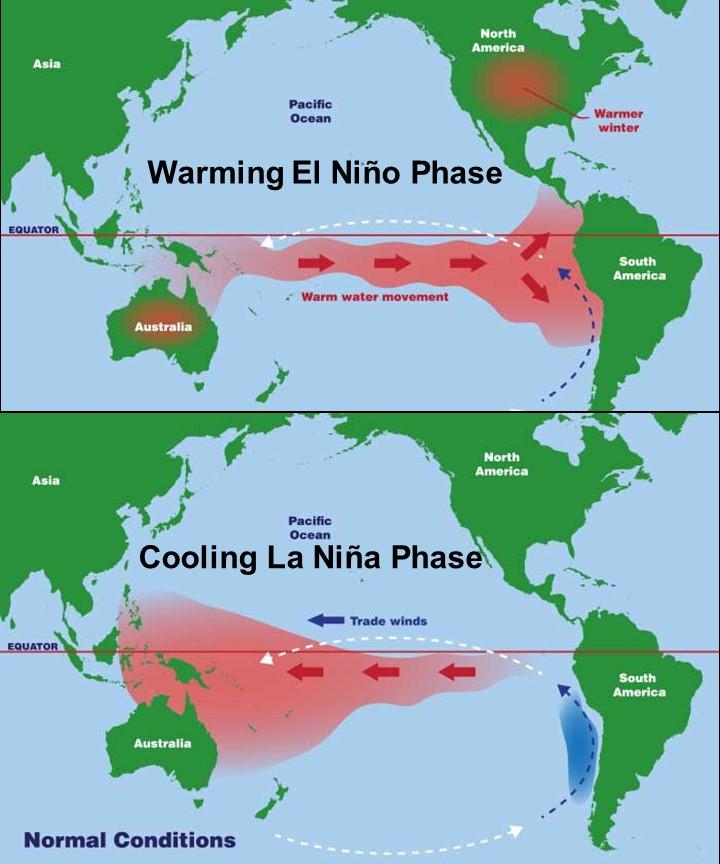
Oceanographer and certified consulting meteorologist Bob Cohen concurred. He said there’s currently a transition from El Niño patterns to La Niña, which is “correlated with higher-than-normal hurricane activity.”
“Right now, the subsurface temperatures are much cooler than during El Niño,” he told The Epoch Times. “The immediate near-surface temperatures are still warmer, but the subsurface water pool and the warm water pool have dissipated, and so once that pops to the surface, it becomes La Niña,” Mr. Cohen said.
He said he expects “we’ll hear a lot more alarmist messaging” if 2024 is a busy hurricane season, as predicted. But, like Mr. Bastardi, Mr. Cohen said hurricanes aren’t getting bigger or more intense. He said that as temperatures naturally warm coming out of the Little Ice Age, hurricanes and weather events will get less intense—not exponentially worse.
Basic Physics and Temperature
The Earth endeavors to exist in a state of equilibrium; it tries to equalize the temperature between the equator and the poles, which drives weather, according to Mr. Cohen.

“When you look at the 50,000-foot big picture, the Earth is a heat engine,” he said. “The tropics remain fairly constant in temperatures, and it’s the poles that have the greatest change.
“The gradient drives the storms. … If the poles warm, the temperature gradient decreases, which would mean less of a requirement for more intense storms from Mother Nature. It’s basic physics.”
Mr. Bastardi agreed.
“Look at Ida versus Betsy,” he said. “Betsy’s hurricane-force winds extended out 150 miles to the west and 250 miles east. Ida 50 miles to the west, and 75 miles to the east. They’re both category 4. They both had similar pressures. Which was the worst storm? The bigger storm. But they don’t tell you that.”
NOAA’s hurricane division shows Hurricane Betsy hitting Florida and Louisiana in 1965 with a central pressure of 946 millibars and a maximum wind speed of 132 miles per hour. Hurricane Ida hit Louisiana in 2021 with a central pressure of 931 mb and a maximum wind speed of 149 miles per hour. However, NOAA data doesn’t include the overall size of a hurricane.

“Hurricanes now are like fists of furry rather than giant bulldozers that come in and plow the coast,” Mr. Bastardi said. “But [NOAA] won’t show the entire picture. Because if they did, people would say, ‘What the heck!’”
He said the reason hurricanes are more costly now is because of increased infrastructure along the coasts, not because of increased severity. NOAA’s historical hurricane data dating back to 1851 supports the premise that hurricanes aren’t getting worse.
It adds as a caveat to its data that “because of the sparseness of towns and cities before 1900,” hurricanes may have been missed or their intensity underestimated. NOAA’s data also shows hurricanes are getting less severe in terms of central pressure.
Even with possible missing data, the NOAA data show an average central pressure decline of 0.00013mb per year between 1851 and 2022 (2023 data isn’t included yet), and max wind had a marginal average increase of 0.00011mph per year for that same period. The agency uses the Saffir-Simpson scale to categorize hurricanes from 1 to 5 based on maximum sustained wind speed.
Fear Before Reality
Government agencies, such as NOAA, often lead with an alarming statement about increased weather severity, but beyond the headlines, the data show a different story, Mr. Cohen said.
For example, in its 2023 State of the Science fact sheet titled “Atlantic Hurricanes and Climate Change,” NOAA asks the questions: “Has human-caused climate change had any detectable influence on hurricanes and their impacts?” and “What changes do we expect going forward with continued global warming?”
It answers itself by stating that “Several Atlantic hurricane activity metrics show pronounced increases since 1980.”
A few paragraphs later, NOAA states that if the data from the 1900s to the present is considered, “There has been no significant trend in annual numbers of U.S. landfalling tropical storms, hurricanes, or major hurricanes.”
Instead, there’s a “decreasing trend since 1900 in the propagation speed of tropical storms and hurricanes over the continental U.S.”
Mr. Cohen said NOAA’s approach is problematic. Its initial statements are “scary” and then “it discounts these same statements.”
“It’s very confusing because it goes back and forth between blaming climate change and blaming natural variability,” he said.
The reliance on climate modeling instead of observed reality is one of the problems with government reports, Mr. Cohen said.
In its fact sheet, NOAA says it hasn’t found clear evidence of a “greenhouse gas-induced change in historical observed Atlantic hurricane behavior.”
“Since a highly confident attribution has not yet been established for Atlantic hurricanes, future projections rely mostly on climate models alone.”
Mr. Cohen said the real observations don’t agree with the models.
“Some will say, ‘Well, if the observations don’t agree, then the observations are wrong.’ But it’s the opposite. It’s the models that are wrong,” he said.
Mr. Bastardi concurred and added that much of what’s being presented to the public is propaganda, not science, intended to facilitate a specific outcome.
“The climate agenda is the nail in freedom’s coffin. We’re more prosperous, we have five times the number of people, and we have one-fiftieth the number of climate disasters than we did in the 1900s,” he said. “But we’ve got this mass brainwashing going on, and it’s all over incremental nonsense—very, very small things that are just amplified to make people think that things are really bad.”
CO2 Impact
When asked if human-caused CO2 has an impact on hurricanes, Mr. Bastardi was quick to say “no.”
Mr. Cohen agreed. “Greenhouse gas doesn’t warm the ocean, except in the top millimeter. The deep warming is caused by the sun. The greenhouse gas theory, which is effect, irradiates heat that tries to escape back down to the Earth in a wavelength that only goes into the oceans at the top—the ocean’s skin or the top few millimeters. So, you don’t get changes in ocean heat content because of greenhouse gasses,” he said.
“You get that because of solar insulation, the direct sunlight, which is a different wavelength. And so, changes in thermal heat content are not due to greenhouse gasses.”
Mr. Bastardi agreed and said there are still a lot of unknowns when it comes to the climate and what causes warming or cooling, particularly in the oceans.
“We’re woefully short of knowing what’s going on in the oceans,” he said. “We have one data point for every 112,000 square miles. It does not do anything except faintly estimate what’s going on.”
He said the increase in geothermal activity in the oceans since 1990 has been warming the oceans. But he’s also seeing a predicted cooling.
“What’s more startling to me is how cold the Indian Ocean is forecast to get over the next six months. I mean, I’ve never seen a drop like this forecasted,” he said.
During the incoming change to the La Niña pattern, upwelling in the oceans brings cold, nutrient-rich water to the surface, pushing the Pacific jet stream northward. That can result in droughts in the southern United States, increased rain and flooding in Canada and the Pacific Northwest, and an increased risk of hurricanes, according to NOAA.
“The warming of the oceans is a big deal,” Mr. Bastardi said. “But there may be a countering going on. As far as La Niña goes, the planet is warming. And it’s warming in a way that creates stronger than average easterly winds across the Pacific, which means upwelling, and upwelling means cooler water.
“All a La Niña is is a resistance to the warming that’s taking place. And unless there is a shutdown of whatever input that is—if you’re a CO2 guy, you think it’s manmade, and if you’re me, you believe it’s natural—until that shutdown occurs, the oceans will continue to warm.
“Now, here’s a dirty little secret: We don’t have the data to know exactly what’s happening.”
Mr. Bastardi predicts this hurricane season “will turn into a real political football” over the climate change narrative.
Mr. Cohen added, “You never see it asked: ‘For humans, what is the optimal temperature?’
“Nine times more people die from cold than heat. The yields in Africa now because of the CO2 are huge, feeding millions of people. So many articles, particularly in the mainstream media, are written to scare people. And that leads to the general public thinking we’re heading into a bad situation. And that’s not the case.
“Warmer weather is better.”
Sound off about this news on The Liberty Daily Substack.
Bypass Big Tech Censors
Two Storms, One Harvest

Every food crisis in living memory has been a one-shock event. The 2008 price spike was a commodity bubble. The 2020 shortages were a logistics failure. The 2022 grain scare was a war on one exporter’s ports. Each time, the system bent, adjusted, and recovered, and each time the experts assured us afterward that global markets are simply too big and too diversified to fail.
What nobody in Washington seems eager to discuss is that 2026 is shaping up to be something the modern food system has never actually faced. Two independent shocks, one climatic and one geopolitical, are converging on the same harvest cycle at the same time. Not sequentially. Simultaneously.
Start with the weather. The Pacific Ocean is currently building toward what forecasters now openly call a record event. NOAA’s Climate Prediction Center puts the odds of at least a strong El Niño near 88 percent, with roughly two in three odds it reaches “very strong” status, the tier reserved for perhaps three or four events in the entire satellite era. Every major global model now projects a median peak in Super El Niño territory, and most of them project it exceeding the 2015-16 event, which until now held the modern record. Sea surface anomalies were already brushing the super threshold in mid-July, months before these events normally peak. The atmosphere has already shifted into El Niño mode, and the event is forecast to crest in late fall and early winter.
This is not about “climate change.” It’s about the standard cycles of weather, and the cycle we’re currently in is one that has likely devastated societies in the past. We’re better prepared as a society today, but not all Americans are equally prepared.
Serious households have started doing the quiet math on their own. Grocery bills tell part of the story, and the forecast maps tell the rest, which is why long-term food storage has moved from fringe hobby to mainstream line item in the family budget, with established suppliers like Heaven’s Harvest seeing demand from people who five years ago would have rolled their eyes at the idea. That instinct is not paranoia. It is pattern recognition, and the pattern is worth walking through carefully.
Editor’s Note: Heaven’s Harvest IS a sponsor, but the warnings of this article are real and would be written even if we didn’t have a survival food sponsor. With that said, those who take advantage of what they offer can use promo code “Patriot” for 15% off.
The Fertilizer Clock Is Already Running
While the Pacific warms, the second shock has been unfolding in the Strait of Hormuz. The conflict with Iran turned the world’s most important energy chokepoint into a contested waterway, and the consequences reach far beyond the gas pump. Roughly a third of global fertilizer trade moves through Hormuz, and the disruption sent urea prices up 86 percent year over year by March, with a 53 percent jump in a single month.
The World Bank projects energy prices rising about 24 percent in 2026 and fertilizer about 31 percent. By its own accounting, fertilizer prices ran 35 percent higher in the first five months of this year than the same period last year.
Here is the mechanism the nightly news will not explain. Fertilizer is not a grocery item. It is a time-delayed input. The nitrogen a farmer in Iowa or Punjab could not afford to apply this spring does not show up as a problem this spring. It shows up as a thinner harvest six to twelve months later.
The World Bank’s own food security brief concedes that the effects of reduced applications earlier this season “are likely to become visible only later in harvest outcomes.” Translate that from institutional language into plain English and it means this. The damage is already done, it is already in the ground, and we are simply waiting for it to arrive on the shelf.
Now check the calendar. Six to twelve months from the spring planting season lands us squarely in late 2026 and early 2027. Which is precisely when the strongest El Niño in the instrumental record is forecast to peak, bringing its signature droughts to Southeast Asia, Australia, southern Africa, northern Brazil, and South Asia, the very regions that grow the world’s rice, sugar, and oilseeds.
The World Bank warns openly that a strong El Niño “could disrupt multiple crop belts simultaneously” on top of the conflict-driven input costs. Their baseline projection assumes the Middle East disruptions ease by autumn. What in the last two years of Middle East history suggests that assumption is safe?
The System Has No Slack Left
The comfortable answer is that global markets always adjust. But adjustment requires slack, and the slack is gone. Global cereal production is expected to decline from last year’s records even before El Niño does its work. The UN World Food Programme, hardly a den of right-wing preppers, is calling this the most significant disruption to its supply chains since Covid and the invasion of Ukraine, and its supply chain director put the stakes bluntly.
Today’s supply chain challenges are tomorrow’s hunger crisis.
There is also a political dimension that markets cannot price. When food gets scarce, governments do not behave like economists. They behave like politicians. Export bans, hoarding mandates, and panic buying at the national level turned the modest rice shortfall of 2008 into a global crisis, and analysts are already warning that import-dependent nations are the first dominoes.
The 2015-16 Super El Niño, a far weaker event than what is now forecast, threw tens of millions into food stress across Africa and Asia. This one is projected to be stronger, and it arrives with fertilizer already rationed by price and shipping lanes already contested by missiles.
What Joseph Knew
Scripture does not treat preparation for lean years as faithlessness. It treats it as wisdom delivered in advance to those willing to act on it.
Behold, there come seven years of great plenty throughout all the land of Egypt: And there shall arise after them seven years of famine; and all the plenty shall be forgotten in the land of Egypt.
Joseph did not respond to that warning with a hashtag or a committee. He stored grain during the years of abundance, and when the famine came, Egypt stood while its neighbors begged. The lesson is not that famine is certain. It is that the time to prepare is precisely when preparation still looks optional.
Nobody who filled a pantry in a year of plenty has ever regretted it, and nobody standing in an empty aisle has ever been glad he waited for certainty.
None of this calls for panic, and panic is the enemy of sound judgment anyway. It calls for the same unglamorous prudence our grandparents considered ordinary. Keep some cash margin, know your local growers, and put real food in deep storage while it is cheap and available, because the entire arc of this story is that cheap and available is a closing window.
Families looking for a straightforward place to start can visit Heaven’s Harvest and use promo code Patriot for 15 percent off long-term storable food. The forecasts may yet soften, the strait may yet reopen, and we should pray they do. But hope is a fine thing to hold and a foolish thing to eat.