


(The Epoch Times)—The U.S. Missile Defense Agency is already searching for cutting-edge missile defense technologies after President Donald Trump signed a new executive order, calling for an “Iron Dome for America.”
The executive order gave the Department of Defense 60 days to evaluate the U.S. missile defense network and overhaul it with hypersonic weapon sensors, space-based missile interceptors, and other so-called “non-kinetic” missile defense capabilities.
Trump has also tasked military leaders with conceiving new ways to stop incoming threats earlier than ever before, including before they launch.
Four days after Trump signed the order, the Missile Defense Agency published a request for information from arms industry insiders on promising advancements to meet Trump’s call for a better missile defense shield.
The quick turnaround suggests the Trump administration is urgently pursuing advanced new strategic defenses at a moment of growing U.S. competition with Russia and China.
Both nations have made advances in offensive strategic weapons technology in recent years, and the U.S. military has struggled to keep pace.
While Trump’s order calls for several new missile defense capabilities, a major focus is on evaluating what systems already exist and whether they’re deployed in the right manner to protect the United States and forward-deployed U.S. troops and allies.
Daniel Flesch, a senior policy analyst for the Allison Center for National Security at the Heritage Foundation, described Trump’s order as a holistic approach that expands on capabilities the U.S. military already has.
JD’s manually curated links for God-fearing MAGA patriots
“Where are the gaps, and where do we need to develop or invest?” Flesch told The Epoch Times.
The launch trajectory of a strategic weapon like a nuclear-armed intercontinental ballistic missile (ICBM) is generally divided into three phases.
The “boost phase” is the initial stage as a weapon burns its propellant at launch. After a ballistic missile expends most of its propellant in the liftoff, it begins its main course of flight toward its target, known as the “midcourse.”
Finally, after reaching the apex of its trajectory, a ballistic missile will fall toward its target in what’s known as the “terminal phase” of its trajectory.
The U.S. Navy currently has both land and ship-based variants of the SM-3 missile that can intercept enemy ballistic missiles in space, at the height of their mid-course flight. The U.S. Army also has ground-based interceptors for mid-course interceptions.
For ballistic missile interceptions in the terminal phase of flight, the Navy has the ship-based SM-6 missile, while the Army has the Terminal High Altitude Area Defense system and newer variants of the Patriot air-defense missile system.
The midcourse presents the largest window for an intercept but requires sophisticated interceptors capable of reaching ballistic missiles at high altitudes, including in space.
Terminal phase interceptors don’t have to reach as high as midcourse interceptors, but it’s a narrow and high-stakes window to stop a ballistic missile before it reaches its final target.
The boost phase presents an attractive opportunity to stop a missile threat because the missile is less capable of evading interceptors or deploying decoys, but detecting a launch in this early stage is difficult, as is having an effective system in position to stop it.
Along with new and improved sensors for tracking the trajectory of weapons throughout their flight, Trump’s order envisions a network of space-based interceptors that could stop threats in their boost phase.
Weapons researchers have long considered high-powered lasers as one potential option for boost phase interceptions.
The United States and Israel have both seen advancements with lasers for intercepting drones and missiles, but more improvements may be needed to effectively counter sophisticated ballistic missiles.
Trump’s order could potentially renew development for an airborne laser system for boost-phase interceptions, such as the U.S. Air Force’s shelved Boeing YAL-1 airborne laser aircraft.
A ‘Star Wars’ Sequel
Trump’s Iron Dome for America takes direct inspiration from the Strategic Defense Initiative (SDI), a missile defense program President Ronald Reagan put in motion in 1983.
“President Ronald Reagan endeavored to build an effective defense against nuclear attacks, and while this program resulted in many technological advances, it was canceled before its goal could be realized,” Trump’s order states.
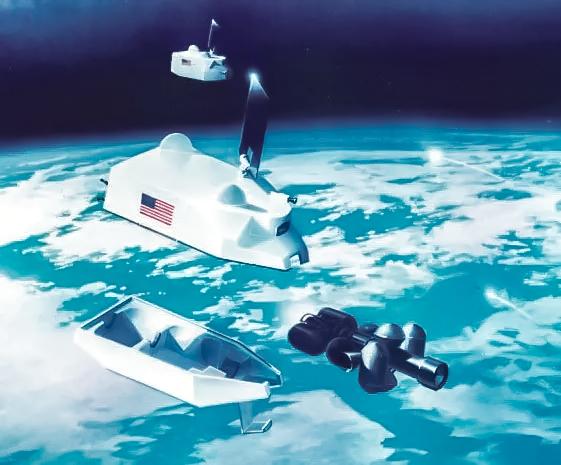
SDI indeed looked to develop space-based and non-kinetic interception capabilities that many critics dismissed as figments of science fiction. The initiative was referred to, often derisively, as Reagan’s “Star Wars” program.
Trump’s concept for a network of space-based interceptors bears a close resemblance to at least one SDI concept, codenamed “Brilliant Pebbles,” which called for the deployment of potentially thousands of small satellites, each armed with interceptors to stop enemy ballistic missiles in the boost phase.
Eric Gomez, an independent analyst who previously researched arms control and nuclear stability topics for the Cato Institute, said an improved layer of space-based sensors for tracking ballistic missiles is among the most feasible technological advancements Trump’s order describes, while space-based interceptors are among the most challenging to achieve.

Gomez assessed Trump’s order may bring about some renewed research on space-based interceptor technology, but expressed doubts such systems will be ready in the next five years.
He did, however, note private enterprises such as Space X have demonstrated the ability to put expansive networks of satellites in orbit.
“Historically, part of the problem with them is that the tech was really hard to make work, and the cost to launch things was high,” Gomez told The Epoch Times.
“Now launch costs are coming down with companies like Space X.”
Space X is operated by Elon Musk, who has been a close ally to Trump in recent months.
Flesch, likewise, categorized the space-based interception capabilities as a more futuristic piece of Trump’s order, while acknowledging advancements by private enterprises have lowered space launch costs in recent years.

Gomez and Flesch also noted challenges surrounding the efficacy of non-kinetic interceptor systems, such as lasers. Atmospheric conditions such as water vapor would make laser interceptor systems less effective over longer ranges.
An aircraft could potentially bring a high-powered laser into effective range to intercept a missile threat as it launches, but Flesch noted fairly large aircraft are needed to support a laser powerful enough to damage a ballistic missile, and those aircraft would have to fly in regular shifts to be in position for such a purpose.

In his March 23, 1983 speech announcing SDI, Reagan fully acknowledged the technology he envisioned could take years, if not decades to mature.
“We’re talking about a process that may not reach fruition until the turn of the century,” Reagan said at the time.
Breaking MAD
As the Soviet Union joined the United States as a nuclear-armed power and ushered in the Cold War era, nuclear deterrence theory quickly centered on a concept known as mutual assured destruction (MAD).
In essence, the MAD theory meant the thing that kept the Soviets from launching a nuclear attack on the United States was the knowledge that Washington would match the attack blow for blow, taking the Soviets down with them.
If the United States can develop the means to effectively and consistently intercept the majority of enemy nuclear attacks, it can move away from a deterrence model based on mutual vulnerability.
The first U.S. anti-ballistic missile, the Nike Zeus, saw development through the late 1950s and early 1960s and entailed using a low-yield nuclear weapon to provide enough blast radius to destroy an incoming enemy ballistic missile.
Missile defense systems may insulate one nation against the consequences of a mutual exchange of nuclear strikes with an adversary, but developing these defenses could fuel distrust with nuclear-armed competitors such as Russia and China.
“If the U.S. has a missile defense system that is a lot better than the Soviet one, then we could conceivably launch a first strike on the Soviet Union and be in a better position to negate the retaliation,” Gomez said.
In 1972, the United States and the Soviet Union entered into the Anti-Ballistic Missile (ABM) Treaty, wherein both sides agreed to limit the number of systems they would employ to counter a potential nuclear attack from the other.
Gomez said the ABM Treaty was meant to put the United States and the Soviet Union on equal footing in their defensive capabilities to reduce the pressure on either side to produce greater offensive capabilities.
The ABM Treaty was one product of the 1969 Strategic Arms Limitation Talks, which also included an interim agreement capping either side’s offensive nuclear arsenals.
President George W. Bush ordered the unilateral U.S. withdrawal from the ABM Treaty in December 2001, stating the agreement hindered the U.S. government’s ability to develop defenses against attacks from terrorists and rogue states.
Gomez said the erosion of past arms control treaties has already inspired competitors to develop new nuclear offensive capabilities, and warned that Trump’s new push for expanded defensive capabilities could fuel further distrust.
He noted Russia has recently developed and demonstrated new offensive capabilities, including nuclear-tipped torpedoes.
Russia also struck Ukraine in November with a new medium-range ballistic missile variant that Russian President Vladimir Putin has bragged modern missile defense systems would struggle to intercept.
Art of the Deal
Trump’s effort to revamp the U.S. missile defenses could dovetail with plans to reach new arms control agreements with both Russia and China.

He raised this very prospect as he delivered a virtual address to the World Economic Forum in Davos, Switzerland, on Jan. 23.
“We want to see if we can denuclearize, and I think that’s very possible. And I can tell you that President Putin wanted to do it. He and I wanted to do it. We had a good conversation with China,” Trump said via video link.
“They would have been involved, and that would have been an unbelievable thing for the planet.”
Reagan had declined requests from Soviet leader Mikhail Gorbachev to discontinue his SDI missile defense program but had offered to share technology from the program with the Soviets as a trust-building measure on the path to denuclearization.
Full denuclearization never prevailed, but Reagan and Gorbachev did agree to the Intermediate Nuclear Forces Treaty, wherein the United States and the Soviet Union agreed to do away with ground-based missiles with a range of between 500 and 5,500 kilometers (about 310 and 3,420 miles).
“If that’s the goal of the administration, to have an arms reduction treaty or discussion, then this can certainly aid in that,” Flesch said of Trump’s missile defense order.
Gomez also considered the possibility that Trump’s missile defense executive order could facilitate further arms control talks but expressed doubts there’s enough trust to make a deal encompassing the United States, Russia, and China.
He assessed China will likely wish to stockpile more nuclear warheads, to achieve relative parity with Russia and the United States, before it will join a framework for mutual nuclear arms reduction.
“I’m generally pessimistic on the prospects,” Gomez said.
Bypass Big Tech Censors
Two Storms, One Harvest

Every food crisis in living memory has been a one-shock event. The 2008 price spike was a commodity bubble. The 2020 shortages were a logistics failure. The 2022 grain scare was a war on one exporter’s ports. Each time, the system bent, adjusted, and recovered, and each time the experts assured us afterward that global markets are simply too big and too diversified to fail.
What nobody in Washington seems eager to discuss is that 2026 is shaping up to be something the modern food system has never actually faced. Two independent shocks, one climatic and one geopolitical, are converging on the same harvest cycle at the same time. Not sequentially. Simultaneously.
Start with the weather. The Pacific Ocean is currently building toward what forecasters now openly call a record event. NOAA’s Climate Prediction Center puts the odds of at least a strong El Niño near 88 percent, with roughly two in three odds it reaches “very strong” status, the tier reserved for perhaps three or four events in the entire satellite era. Every major global model now projects a median peak in Super El Niño territory, and most of them project it exceeding the 2015-16 event, which until now held the modern record. Sea surface anomalies were already brushing the super threshold in mid-July, months before these events normally peak. The atmosphere has already shifted into El Niño mode, and the event is forecast to crest in late fall and early winter.
This is not about “climate change.” It’s about the standard cycles of weather, and the cycle we’re currently in is one that has likely devastated societies in the past. We’re better prepared as a society today, but not all Americans are equally prepared.
Serious households have started doing the quiet math on their own. Grocery bills tell part of the story, and the forecast maps tell the rest, which is why long-term food storage has moved from fringe hobby to mainstream line item in the family budget, with established suppliers like Heaven’s Harvest seeing demand from people who five years ago would have rolled their eyes at the idea. That instinct is not paranoia. It is pattern recognition, and the pattern is worth walking through carefully.
Editor’s Note: Heaven’s Harvest IS a sponsor, but the warnings of this article are real and would be written even if we didn’t have a survival food sponsor. With that said, those who take advantage of what they offer can use promo code “Patriot” for 15% off.
The Fertilizer Clock Is Already Running
While the Pacific warms, the second shock has been unfolding in the Strait of Hormuz. The conflict with Iran turned the world’s most important energy chokepoint into a contested waterway, and the consequences reach far beyond the gas pump. Roughly a third of global fertilizer trade moves through Hormuz, and the disruption sent urea prices up 86 percent year over year by March, with a 53 percent jump in a single month.
The World Bank projects energy prices rising about 24 percent in 2026 and fertilizer about 31 percent. By its own accounting, fertilizer prices ran 35 percent higher in the first five months of this year than the same period last year.
Here is the mechanism the nightly news will not explain. Fertilizer is not a grocery item. It is a time-delayed input. The nitrogen a farmer in Iowa or Punjab could not afford to apply this spring does not show up as a problem this spring. It shows up as a thinner harvest six to twelve months later.
The World Bank’s own food security brief concedes that the effects of reduced applications earlier this season “are likely to become visible only later in harvest outcomes.” Translate that from institutional language into plain English and it means this. The damage is already done, it is already in the ground, and we are simply waiting for it to arrive on the shelf.
Now check the calendar. Six to twelve months from the spring planting season lands us squarely in late 2026 and early 2027. Which is precisely when the strongest El Niño in the instrumental record is forecast to peak, bringing its signature droughts to Southeast Asia, Australia, southern Africa, northern Brazil, and South Asia, the very regions that grow the world’s rice, sugar, and oilseeds.
The World Bank warns openly that a strong El Niño “could disrupt multiple crop belts simultaneously” on top of the conflict-driven input costs. Their baseline projection assumes the Middle East disruptions ease by autumn. What in the last two years of Middle East history suggests that assumption is safe?
The System Has No Slack Left
The comfortable answer is that global markets always adjust. But adjustment requires slack, and the slack is gone. Global cereal production is expected to decline from last year’s records even before El Niño does its work. The UN World Food Programme, hardly a den of right-wing preppers, is calling this the most significant disruption to its supply chains since Covid and the invasion of Ukraine, and its supply chain director put the stakes bluntly.
Today’s supply chain challenges are tomorrow’s hunger crisis.
There is also a political dimension that markets cannot price. When food gets scarce, governments do not behave like economists. They behave like politicians. Export bans, hoarding mandates, and panic buying at the national level turned the modest rice shortfall of 2008 into a global crisis, and analysts are already warning that import-dependent nations are the first dominoes.
The 2015-16 Super El Niño, a far weaker event than what is now forecast, threw tens of millions into food stress across Africa and Asia. This one is projected to be stronger, and it arrives with fertilizer already rationed by price and shipping lanes already contested by missiles.
What Joseph Knew
Scripture does not treat preparation for lean years as faithlessness. It treats it as wisdom delivered in advance to those willing to act on it.
Behold, there come seven years of great plenty throughout all the land of Egypt: And there shall arise after them seven years of famine; and all the plenty shall be forgotten in the land of Egypt.
Joseph did not respond to that warning with a hashtag or a committee. He stored grain during the years of abundance, and when the famine came, Egypt stood while its neighbors begged. The lesson is not that famine is certain. It is that the time to prepare is precisely when preparation still looks optional.
Nobody who filled a pantry in a year of plenty has ever regretted it, and nobody standing in an empty aisle has ever been glad he waited for certainty.
None of this calls for panic, and panic is the enemy of sound judgment anyway. It calls for the same unglamorous prudence our grandparents considered ordinary. Keep some cash margin, know your local growers, and put real food in deep storage while it is cheap and available, because the entire arc of this story is that cheap and available is a closing window.
Families looking for a straightforward place to start can visit Heaven’s Harvest and use promo code Patriot for 15 percent off long-term storable food. The forecasts may yet soften, the strait may yet reopen, and we should pray they do. But hope is a fine thing to hold and a foolish thing to eat.