


 (DCNF)—The new head of Anthony Fauci’s former institute has accrued an extraordinary amount of research money and power in recent weeks despite a long career conducting just the sort of high-risk virology that President Donald Trump’s health leaders have vowed to stamp out.
Virologist Jeffery Taubenberger, a longtime Fauci ally who for more than a decade has defended the practice of enhancing viruses known as gain-of-function (GOF) virology, ascended to the top of the National Institute of Allergy and Infectious Diseases (NIAID) on April 24. His bosses, Health and Human Services (HHS) Secretary Robert F. Kennedy Jr. and National Institutes of Health (NIH) Director Jay Bhattacharya, oppose GOF as potentially catastrophic.
One week after Taubenberger became head of NIAID, HHS announced May 1 that it would make a half a billion-dollar investment in a vaccine technology co-invented by Taubenberger. Taubenberger could receive royalty payments and lab investments should the taxpayer-funded bet on the vaccine technology prove successful, according to government watchdog Open the Books (OTB).
Taubenberger’s rise to the top of the second largest subagency at Bhattacharya’s NIH follows a career marked by headline-grabbing GOF research.
Taubenberger’s most famous experiments involved what his lab’s website refers to as “archaevirology”— reviving the 1918 Spanish flu that killed up to 100 million people from a body preserved in permafrost. Taubenberger has also participated in experiments to splice genes from 1918 flu with contemporary H1N1 viruses. Critics like Kennedy and Bhattacharya say gain-of-function experiments like these have no public health benefit.
Taubenberger did not respond to requests for comment for this story.
‘The Complaining Crowd’
As the virologist behind some of the most famous GOF experiments in history, Taubenberger worked with Fauci to advocate for the discipline against the concerns from other scientists about lab-born pandemics, emails obtained through the Freedom of Information Act show.
“The complaining crowd”: That’s how Taubenberger referred in a May 2020 email to people concerned about one of the earliest and most hotly debated GOF experiments — the creation of an airborne H5N1 avian influenza virus. The World Health Organization estimates the fatality rate of H5N1 to be roughly 50%.
- Hand-curated links from conservative and Christian sites — NO legacy media garbage links. Patriots get their news every day at JDRucker.com
Taubenberger’s elevation to NIAID director shows the practical challenges of “draining the swamp.” Kennedy and Bhattacharya, despite ambitions for upheaval, face an entrenched Washington bureaucracy.
Taubenberger’s leadership of the $6.6 billion institute is temporary, but it comes at a sensitive moment.
As the head of NIAID, the agency that underwrites most federally-funded GOF, Taubenberger is well-positioned to influence new regulations. His leadership coincides with a 120-day sprint to ban “dangerous gain-of-function research.” Trump signed an executive order on May 6 that started the clock on a four-month process to hammer out the precise language.
“I was very disappointed by the appointment of Jeffrey Taubenberger as head of NIAID,” Laura Kahn, a pandemic expert and coauthor of the book “One Health and the Politics of COVID-19,” told the Daily Caller News Foundation. “Given Taubenberger’s research history, his appointment suggests that such work will continue to be supported by NIAID despite Trump’s executive order. Have we learned nothing from COVID-19?”
Taubenberger’s reconstruction of the 1918 influenza virus “sent a terrible message to China and Russia that dangerous GOF work was acceptable,” Kahn said.
In contrast, virologists who support GOF have praised the pick.
“He’s a senior scientist at NIH and a collaborator of Matthew Memoli who was acting NIH director … Huge plus that the lab leak conspiracists over on X are so upset about it,” wrote University of Sydney virologist Eddie Holmes on BlueSky. Holmes is a collaborator of Taubenberger and one of the virologists who aided Fauci in downplaying a possible lab origin of COVID in 2020.
When the COVID-19 pandemic emerged, Taubenberger worked with Fauci’s disgraced senior scientific adviser David Morens to defend the researchers who had conducted GOF research in Wuhan. He and Morens coauthored a July 2020 scientific paper arguing that “theories about a hypothetical man-made origin” of the coronavirus “have been thoroughly discredited.”
The article published at an opportune time for Wuhan Institute of Virology collaborator Peter Daszak, whose organization EcoHealth Alliance faced the possible clawback of NIH funding if it couldn’t produce critical data about its coronavirus research in China. Morens described the article as one that “defends Peter and his Chinese colleagues.”
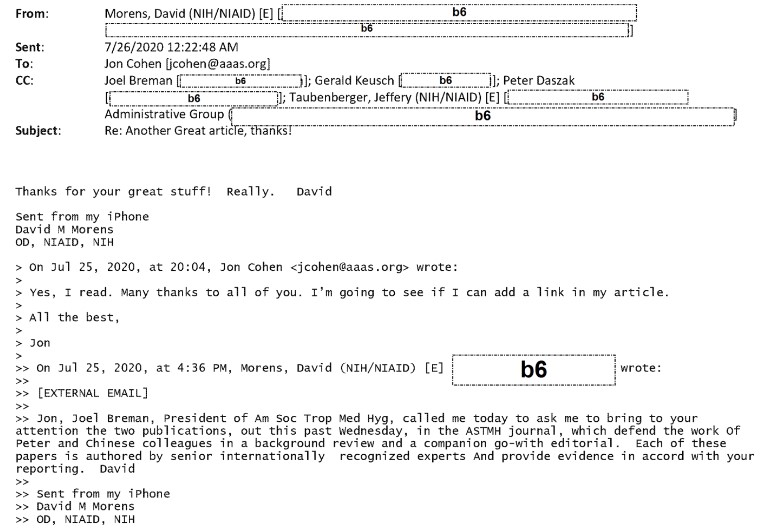
Sure enough, Daszak received a new $7.5 million grant from NIAID by August 2020 even without turning over information from Wuhan.
Morens later faced bipartisan criticism in 2024 for emails exposing his attempts to evade the Freedom of Information Act in his communications with Daszak, a longtime friend. Morens said that he would “delete any smoking guns.”
With help from officials within NIH like Taubenberger, Daszak stalled the suspension of his NIH funding. It was roughly four years later, after a congressional investigation, that EcoHealth and Daszak faced a federal funding suspension and, eventually, debarment.
‘Nature Is The Ultimate Bioterrorist’
Taubenberger’s public statements on GOF research — while more measured than the private communications mocking people with concerns — contrasts starkly with that of his bosses.
“In considering the threat of bioterrorism or accidental release of genetically engineered viruses, it is worth remembering that nature is the ultimate bioterrorist,” reads Taubenberger’s 2012 article defending the avian influenza experiment.
That position directly contradicts comments Bhattacharya gave on May 7 in a television interview citing that work as emblematic of the GOF the NIH plans to fetter out.
“That avian influenza work, I think it was in 2010 or 2011, and it led President Obama to actually put a freeze on all gain-of-function work which President Obama lifted almost on his last day in office in 2017,” Bhattacharya said in an interview with Newsmax. “Anything that puts the American people at risk like this is not something we at the NIH should be doing.”
Kennedy too was critical of that experiment in his 2023 book “The Wuhan Cover-Up And the Terrifying Bioweapons Arms Race.”
Morens grumbled in an April 2020 email that he and Taubenberger had defended GOF research before against “Ludditism.”

“I am sure both of you remember the GOF attacks of a decade ago,” he said. “tony, me, Jeff Taubenberger, and many others here had to do battle with a lot of craziness. … It was much less [sic] about science than [it] was about Ludditism.”
In a separate May 2020 email, Morens reiterates the important role that he and Taubenberger played in advocating for GOF and combating the concerns of scientists at Stanford University, Harvard University and Rutgers University, which he described as “demagoguery.”
“As Tony’s scientific advisor, i spent much of the year, along with Jeff T, helping brief him and get him up to speed,” he said.
‘Leopard That Hasn’t Changed Its Spots’
The COVID-19 pandemic did not appear to dampen Taubenberger’s enthusiasm for GOF research. Taubenberger said in a December 2022 podcast interview with another prominent advocate for GOF virology that he aspired to revive other pre-1918 pandemic viruses through “archival tissues” from human autopsies, including viruses that caused pandemics in the Middle Ages.
“With the newer molecular techniques, I’ve consistently remained hopeful that someday the magic tissue sample will be found,” Taubenberger said.
The Central Intelligence Agency, the Federal Bureau of Investigation and the Department of Energy all have intelligence pointing to a lab origin of COVID-19.

Taubenberger’s support of GOF research three years after COVID-19 emerged is troubling, according to Andrew Noymer, an associate professor of population health and disease prevention at the University of California, Irvine.
“Any leopard that hasn’t changed its spots already in the light of SARS-CoV-2, I’m skeptical will change its spots now,” Noymer said to DCNF. “I’m all for road to Damascus conversions, but if you can be pro-gain of function in December 2022, then it seems to me you’re a dyed in the wool pro-gain-of-function person and therefore not the right choice to implement the recent executive order.”
Vaccine ‘Gold’
Within a week of Taubenberger taking the reins at NIAID, he started ruffling feathers.
HHS will devote massive departmental resources toward the development of a flu vaccine platform co-owned by Taubenberger in the hopes it will provide broad protection against multiple strains of pandemic-capable flu viruses, the department announced earlier this month.
HHS has dubbed the initiative “Generation Gold Standard.”
The money has been rejiggered from a $5 billion investment by the Biomedical Advanced Research and Development Authority (BARDA) and NIAID in next generation COVID-19 vaccines announced in 2023.
The vaccine prototypes — blandly named “BPL-1357” and “BPL-24910” — are BPL-inactivated whole-virus vaccines, a technology that has been in use since the 1950s. “BPL” stands for beta-propiolactone, a chemical used in vaccines to inactivate viruses, destroying their infectivity while retaining their ability to provoke an immune response.
Taubenberger holds two patents titled “Broadly Protective Inactivated Influenza Virus Vaccine.”
The new investment builds on the research of Taubenberger and his longtime collaborator Matthew J. Memoli, Bhattacharya’s principal deputy.
HHS said in its statement announcing Generation Gold Standard that the investment has “freedom from commercial conflicts of interest.”
But there’s another apparent conflict of interest: Should the vaccine prove safe and effective, Taubenberger could earn up to $150,000 annually and additional funds for his lab, per an investigation into NIH royalty payment rules by OTB.
NIH insists firewalls prevent the undue influence of patent holders on grant-making decisions but with few specifics. Then-NIH Acting Director Lawrence Tabak could not precisely describe the firewalls when pressed by congressional Republicans in May 2022, according to an August 2023 OTB investigation.
Some scientists criticize the surge in HHS resources toward a decades-old technology, according to press reports.
The investment is a major career milestone for Taubenberger, a Fauci-aligned expert who has not only survived but thrived in a department now led by self-declared “renegades” like Kennedy.
The success comes despite a career and declared worldview starkly at odds with the renegade ethos of his bosses.
“My wife bought me a mug that says ‘my medical degree is worth more than your Google search,’” Taubenberger said in the 2022 podcast interview.
All content created by the Daily Caller News Foundation, an independent and nonpartisan newswire service, is available without charge to any legitimate news publisher that can provide a large audience. All republished articles must include our logo, our reporter’s byline and their DCNF affiliation. For any questions about our guidelines or partnering with us, please contact [email protected].
Bypass Big Tech Censors
Two Storms, One Harvest

Every food crisis in living memory has been a one-shock event. The 2008 price spike was a commodity bubble. The 2020 shortages were a logistics failure. The 2022 grain scare was a war on one exporter’s ports. Each time, the system bent, adjusted, and recovered, and each time the experts assured us afterward that global markets are simply too big and too diversified to fail.
What nobody in Washington seems eager to discuss is that 2026 is shaping up to be something the modern food system has never actually faced. Two independent shocks, one climatic and one geopolitical, are converging on the same harvest cycle at the same time. Not sequentially. Simultaneously.
Start with the weather. The Pacific Ocean is currently building toward what forecasters now openly call a record event. NOAA’s Climate Prediction Center puts the odds of at least a strong El Niño near 88 percent, with roughly two in three odds it reaches “very strong” status, the tier reserved for perhaps three or four events in the entire satellite era. Every major global model now projects a median peak in Super El Niño territory, and most of them project it exceeding the 2015-16 event, which until now held the modern record. Sea surface anomalies were already brushing the super threshold in mid-July, months before these events normally peak. The atmosphere has already shifted into El Niño mode, and the event is forecast to crest in late fall and early winter.
This is not about “climate change.” It’s about the standard cycles of weather, and the cycle we’re currently in is one that has likely devastated societies in the past. We’re better prepared as a society today, but not all Americans are equally prepared.
Serious households have started doing the quiet math on their own. Grocery bills tell part of the story, and the forecast maps tell the rest, which is why long-term food storage has moved from fringe hobby to mainstream line item in the family budget, with established suppliers like Heaven’s Harvest seeing demand from people who five years ago would have rolled their eyes at the idea. That instinct is not paranoia. It is pattern recognition, and the pattern is worth walking through carefully.
Editor’s Note: Heaven’s Harvest IS a sponsor, but the warnings of this article are real and would be written even if we didn’t have a survival food sponsor. With that said, those who take advantage of what they offer can use promo code “Patriot” for 15% off.
The Fertilizer Clock Is Already Running
While the Pacific warms, the second shock has been unfolding in the Strait of Hormuz. The conflict with Iran turned the world’s most important energy chokepoint into a contested waterway, and the consequences reach far beyond the gas pump. Roughly a third of global fertilizer trade moves through Hormuz, and the disruption sent urea prices up 86 percent year over year by March, with a 53 percent jump in a single month.
The World Bank projects energy prices rising about 24 percent in 2026 and fertilizer about 31 percent. By its own accounting, fertilizer prices ran 35 percent higher in the first five months of this year than the same period last year.
Here is the mechanism the nightly news will not explain. Fertilizer is not a grocery item. It is a time-delayed input. The nitrogen a farmer in Iowa or Punjab could not afford to apply this spring does not show up as a problem this spring. It shows up as a thinner harvest six to twelve months later.
The World Bank’s own food security brief concedes that the effects of reduced applications earlier this season “are likely to become visible only later in harvest outcomes.” Translate that from institutional language into plain English and it means this. The damage is already done, it is already in the ground, and we are simply waiting for it to arrive on the shelf.
Now check the calendar. Six to twelve months from the spring planting season lands us squarely in late 2026 and early 2027. Which is precisely when the strongest El Niño in the instrumental record is forecast to peak, bringing its signature droughts to Southeast Asia, Australia, southern Africa, northern Brazil, and South Asia, the very regions that grow the world’s rice, sugar, and oilseeds.
The World Bank warns openly that a strong El Niño “could disrupt multiple crop belts simultaneously” on top of the conflict-driven input costs. Their baseline projection assumes the Middle East disruptions ease by autumn. What in the last two years of Middle East history suggests that assumption is safe?
The System Has No Slack Left
The comfortable answer is that global markets always adjust. But adjustment requires slack, and the slack is gone. Global cereal production is expected to decline from last year’s records even before El Niño does its work. The UN World Food Programme, hardly a den of right-wing preppers, is calling this the most significant disruption to its supply chains since Covid and the invasion of Ukraine, and its supply chain director put the stakes bluntly.
Today’s supply chain challenges are tomorrow’s hunger crisis.
There is also a political dimension that markets cannot price. When food gets scarce, governments do not behave like economists. They behave like politicians. Export bans, hoarding mandates, and panic buying at the national level turned the modest rice shortfall of 2008 into a global crisis, and analysts are already warning that import-dependent nations are the first dominoes.
The 2015-16 Super El Niño, a far weaker event than what is now forecast, threw tens of millions into food stress across Africa and Asia. This one is projected to be stronger, and it arrives with fertilizer already rationed by price and shipping lanes already contested by missiles.
What Joseph Knew
Scripture does not treat preparation for lean years as faithlessness. It treats it as wisdom delivered in advance to those willing to act on it.
Behold, there come seven years of great plenty throughout all the land of Egypt: And there shall arise after them seven years of famine; and all the plenty shall be forgotten in the land of Egypt.
Joseph did not respond to that warning with a hashtag or a committee. He stored grain during the years of abundance, and when the famine came, Egypt stood while its neighbors begged. The lesson is not that famine is certain. It is that the time to prepare is precisely when preparation still looks optional.
Nobody who filled a pantry in a year of plenty has ever regretted it, and nobody standing in an empty aisle has ever been glad he waited for certainty.
None of this calls for panic, and panic is the enemy of sound judgment anyway. It calls for the same unglamorous prudence our grandparents considered ordinary. Keep some cash margin, know your local growers, and put real food in deep storage while it is cheap and available, because the entire arc of this story is that cheap and available is a closing window.
Families looking for a straightforward place to start can visit Heaven’s Harvest and use promo code Patriot for 15 percent off long-term storable food. The forecasts may yet soften, the strait may yet reopen, and we should pray they do. But hope is a fine thing to hold and a foolish thing to eat.
Meet the new demon, same as the old demon.