



From August 22 through 24th, an extended coalition of over 40 nations which has become known as BRICS+ will meet in Johannesburg, South Africa. Among the likely topics of discussion is the feasibility of setting up a jointly-owned international financial institution. It would be funded by gold deposits, issue a currency, and extend loans tied to the spot value of gold. There are substantial reasons to doubt the workability of the growing consortium’s plan. But to dismiss it summarily, whether as bad economics or rote anti-American propaganda, is to dismiss a moment five decades in the making.
Throughout the 1990s and into the early dawn of the 21st century, national governments looked down upon a world they credited themselves with creating. A Federal Reserve-engineered ‘soft landing’ in the mid-1990s buttressed the perception of monetary policy as a perfectable science.
The Third Way – not free markets, but a hampered, highly regulated mixed economy – had outlasted and arguably defeated Communism. Technological innovation was vaulting beyond anyone’s wildest expectations. Space was at the forefront of science again, with the launch of the Hubble Space Telescope and construction starting on the International Space Station. Protease inhibitors, bioengineered foods, and the first hybrid vehicles arrived.
US Dollar Index (DXY), Fall of USSR – present
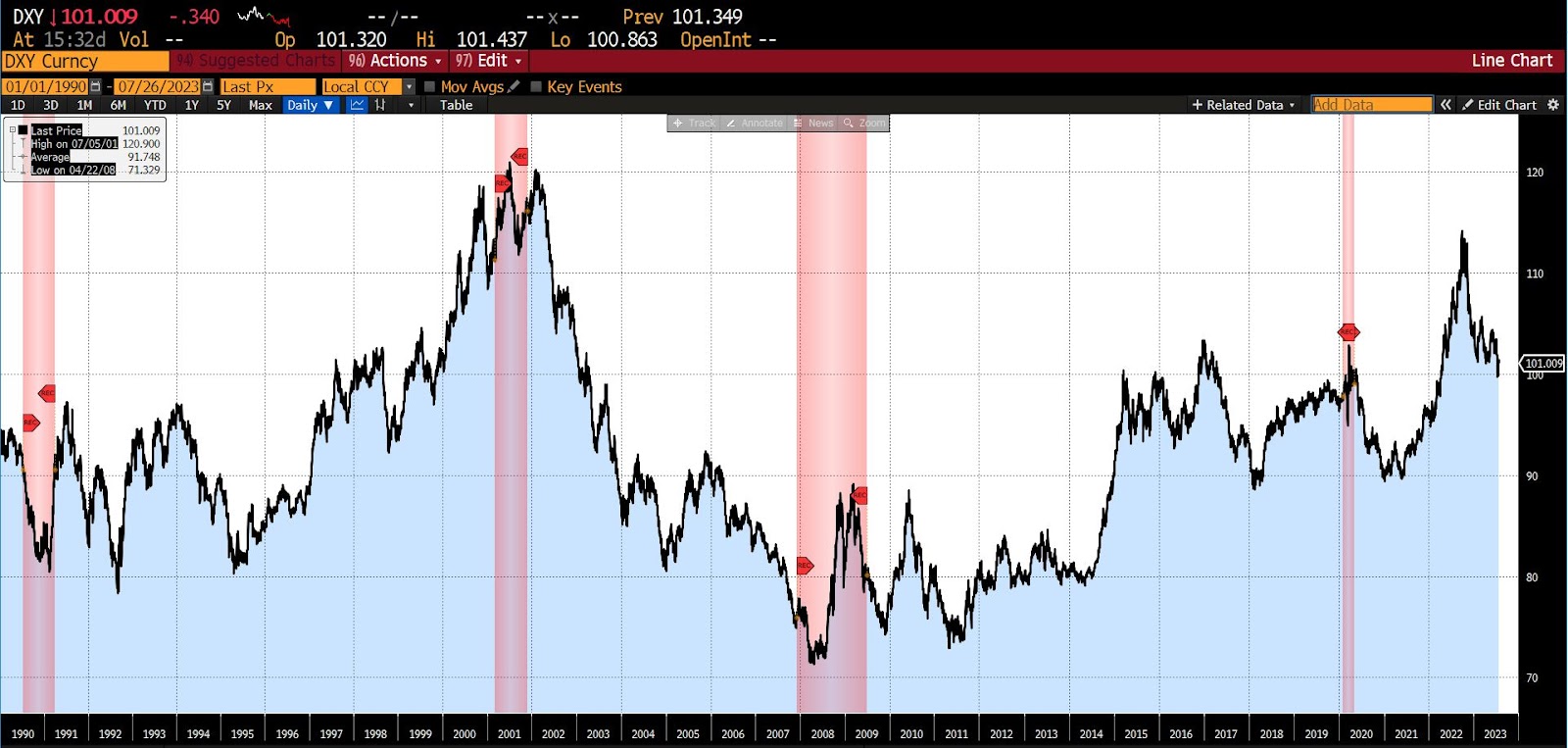
At that time political figures all around the globe, elected and appointed, surveyed a world built upon paper money and financialization. They looked upon it with great, in many cases smug, satisfaction. And among other self-congratulatory measures, they began selling their long-held gold reserves – by the ton. England, the Netherlands, Australia, Belgium, Canada, and even precious metal stalwart Switzerland liquidated physical stocks of gold. The US did as well, a bit later. Some explained those sales as a means for diversifying central bank holdings. Others claimed that the proceeds would benefit the poor or be used to pay down government debt. A new millennium was at hand, the towpath to which was paved not by soft yellow metal but by batteries of workstations armed with Pentium III processors, silently churning out solutions to partial differential equations.
Twenty-five years later the poor are still poor, national debt is at record levels, and the price of gold in US dollars is eight to ten times the price that governments and central bankers sold almost 5,000 metric tons for. Multi-trillion dollar wars have been fought to inconclusive ends: not lost, really, but far from won. Orders of magnitudes typically only found in astronomy textbooks, invoking trillions (and in Japan, quadrillions) regularly surfaced in the descriptions of monetary and fiscal policy measures of developed nations. Then, on the heels of a highly politicized response to a public health event, inflation returned from a four decade sojourn. One dollar printed during the Y2K scare today purchases roughly 56 percent of what it did then.
Nevertheless, the US dollar has remained the indisputable and essentially singular global reserve currency, acting as a medium of exchange, unit of account, and settlement instrument for the lion’s share of daily international trading.
Despite policy missteps and distractions, the Fed has arguably performed better than most of the world’s other central banks: in the land of the blind, the one-eyed man is king. But the weaponization of the US dollar in 2022 has exposed greenback dependency as a vulnerability of existential proportions. With the banning of most Russian banks from the Swift (Society for Worldwide Interbank Financial Telecommunication) messaging system, and despite the dollar’s advantages for use in global trade, a line was crossed.

Despite petulant insistences to the contrary by the most well-known economist today (regrettably), a wave of de-dollarization is very much underway. It would be interesting to know how Krugman, who scoffed at the description of ejecting a nation from SWIFT as “weaponization,” would characterize French Finance Minister Bruno Le Maier’s dubbing the move a “financial nuclear weapon.”
None of this means that the dollar is “doomed,” and certainly not imminently. Neither is the US dollar “dead.” But its use as a sanctioning instrument likely represents the crossing of a rubicon whereby nations habitually using the dollar need to have currency alternatives ready. US Treasury Secretary Janet Yellen, even while citing the entrenched nature of the dollar in global trade, conceded that “diversif[cation]” in global foreign exchange reserves is underway earlier this month.
The argument that few if any other nations have currencies (and/or economies underlying them) that meet the requirements of a global reserve currency is a cogent one. Of course, one needn’t necessarily replace the dollar. What matters is having a ready means of transacting outside dollar-based systems and institutions in exigent circumstances: to maintain continuity of trade, and to hedge against the policy errors of central bankers. What is the most marketable, least manipulable means of shifting away from the dollar (and possibly back to it, once tensions have abated) with the lowest switching costs? Gold.
Gold in USD, Fall of USSR – present
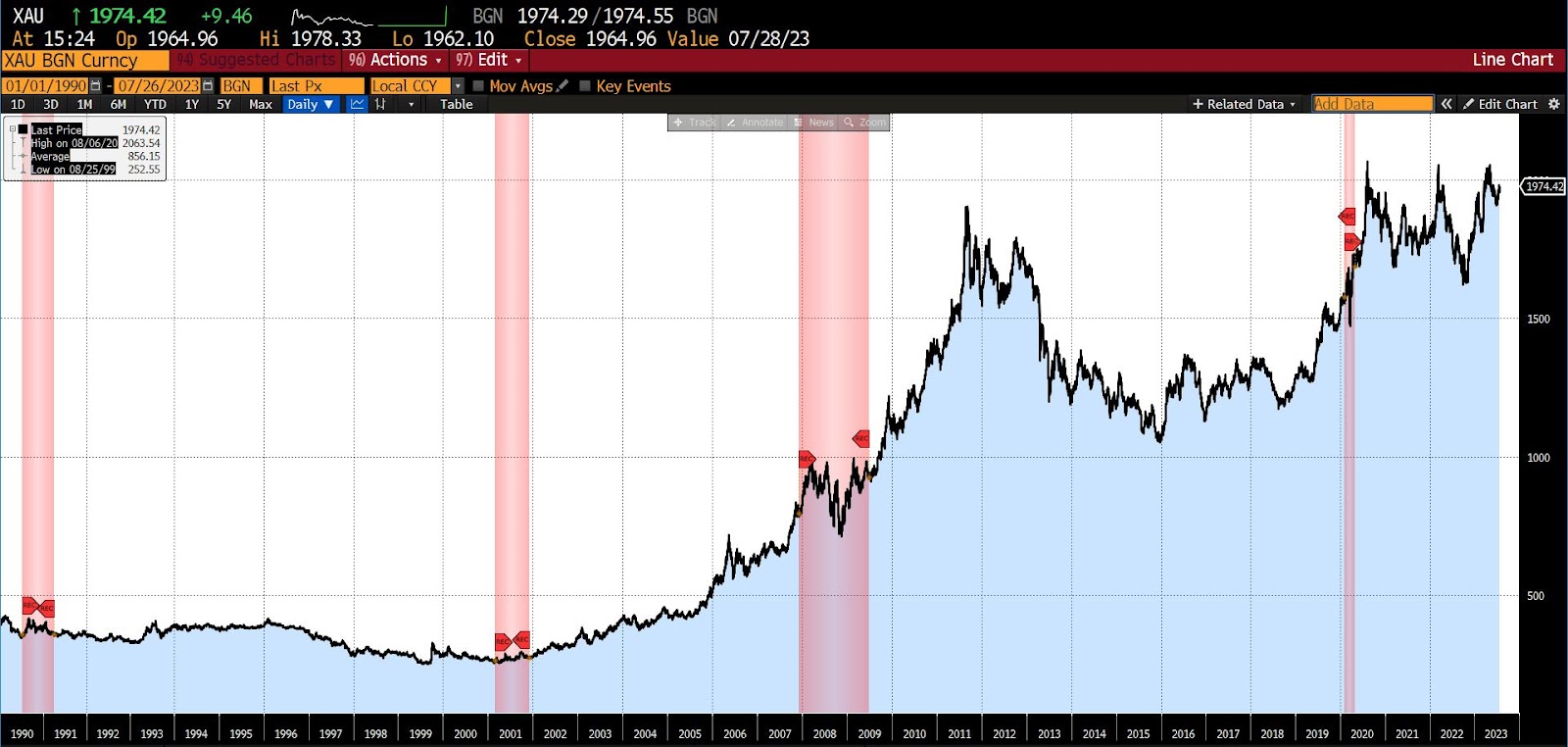
Saudi Arabia, not a particular fan of the current Presidential administration, has indicated that it will invest billions of dollars into its expanding gold sector over the remainder of this decade. India recently launched an international gold bullion exchange. The imposition of (almost) unprecedented non-pharmaceutical interventions in early 2020 saw the price of gold rise to record highs. At the end of last year, central banks were buying gold at the fastest rate since 1967. As of May, 70 percent of central banks indicated believing that gold reserves would increase over the next year. Experimentation with using gold alongside dollars, and as money, including in some innovative, familiar formats here in the US, has been growing in just the last few years.
Specific details on the proposed currency union have not yet been released. They may not yet exist outside the minds of their promoters. Suffice to say that drawing scores of nations together from different continents and cultures, with different histories and remarkably diverse resource endowments will be a heavy lift, organizationally speaking. Smaller members are likely to find their interests marginalized, with the resulting dynamic closer to what’s seen in the United Nations than, say, OPEC. And few of the proposed members have confidence-inspiring track records where property rights are concerned.

The form and function of the BRICS+ financial institution, if any is indeed forthcoming, is of secondary importance. What matters is that the slow creep of de-dollarization is, on its flip side, an inexorable push toward the re-monetization of gold. And whether that means sound money through innovation or pressuring global central banks to reform their practices, those outcomes are welcome to say the least.
Sound off about this article on our Economic Collapse Substack.
About the Author
Peter C. Earle is an economist who joined AIER in 2018. Prior to that he spent over 20 years as a trader and analyst at a number of securities firms and hedge funds in the New York metropolitan area. His research focuses on financial markets, monetary policy, and problems in economic measurement. He has been quoted by the Wall Street Journal, Bloomberg, Reuters, CNBC, Grant’s Interest Rate Observer, NPR, and in numerous other media outlets and publications. Pete holds an MA in Applied Economics from American University, an MBA (Finance), and a BS in Engineering from the United States Military Academy at West Point.
Article cross-posted from AIER.
Bypass Big Tech Censors
Starting the Day With a Scripture-Inspired Roast Helps Center Your Thoughts on Eternal Truths Amid Temporal Pressures
The world can seem chaotic, especially right after we wake up. Many believers start their mornings reaching for something familiar — a hot cup of coffee — yet end up settling for mediocre brews that do little more than deliver a caffeine jolt. The daily grind of life, with its endless distractions, news cycles, and responsibilities, can leave even the most faithful feeling spiritually parched alongside their physical fatigue. What if your morning ritual could do more than wake you up? What if it could ground you in truth, nourish your body with exceptional quality, and quietly advance a kingdom purpose at the same time?
That’s the promise — and the reality — behind Promised Grounds Coffee. This Christian-founded company doesn’t just roast beans; it approaches every step as an act of worship and discipleship. By selecting only the top 10% of specialty-grade beans, ethically sourced from dedicated farmers in Central and South America, and small-batch roasting them with reverence in Austin, Texas, Promised Grounds delivers what many describe as the best coffee available — never burnt, never bland, but rich with origin stories and layered flavors that honor God’s creation.
From the vibrant Psalm 27 Roast (a light, bright medium option) to the bold yet peaceful 2 Timothy 1:7 Decaf, each bag carries a Scripture verse that turns your daily pour into a gentle reminder of faith. And through their Ounce Per Ounce Promise, every ounce of coffee you enjoy provides an equal ounce of clean water to families in need via partnership with Filter of Hope — literally brewing hope for body and soul, one cup at a time.
The challenge for today’s Christians runs deeper than finding a decent cup. In an age of convenience-driven consumerism, it’s easy to support companies that dilute values or remain silent on matters of faith. Many believers want their everyday choices — from what they drink to how they spend — to reflect discipleship rather than just convenience. Promised Grounds solves this by weaving Christian excellence into the entire process: beans nurtured with prayerful stewardship by farming families, roasted as an offering rather than a commodity, and packaged with Bible verses to encourage a mindset of gratitude and purpose from the first sip. Reviewers consistently praise the smooth, rich profiles — whether enjoyed black in a drip maker, iced on a warm day, or shared in fellowship — noting how the quality stands toe-to-toe with premium secular brands while delivering something far more meaningful.
This integration of faith and flavor addresses a real need in Christian households and ministries. Busy parents, church leaders, and remote workers alike report that starting the day with a Scripture-inspired roast helps center their thoughts on eternal truths amid temporal pressures. The coffee’s exceptional character — bright citrus notes in lighter roasts or deep chocolate undertones in bolder ones — comes from meticulous selection and careful roasting that respects the bean’s natural gifts rather than masking them. It’s the kind of coffee that elevates a simple quiet time, fuels productive workdays, or sparks meaningful conversations when shared at Bible studies or outreach events. And because it’s ethically sourced with integrity, every purchase supports sustainable livelihoods for farmers who treat their crops like family harvests.
For those leading churches or small groups, the impact multiplies. Promised Grounds offers bundles and options perfect for hospitality ministries, turning ordinary coffee service into an opportunity to point people toward the living water of Christ. Imagine greeting visitors with a warm cup whose very bag carries God’s Word — a subtle yet powerful witness that aligns with the Great Commission. The company’s Texas roots and commitment to “brewing hope” resonate especially with believers who value American enterprise paired with global compassion.
Of course, quality alone isn’t enough if the experience feels out of reach. Promised Grounds keeps it accessible with practical perks like free shipping on orders over $40, sample sets for discovering favorites, and thoughtful add-ons such as faith-themed mugs. Whether you prefer whole beans for fresh grinding, grounds for convenience, or even bulk options for larger households and ministries, the result is consistently superior coffee that makes discipleship feel integrated rather than added on.
As you consider how to align even the smallest habits with your walk with God, Promised Grounds Coffee stands out as a refreshing solution. It tackles the dual problems of subpar daily sustenance and disconnected consumption by offering a product that genuinely excels in taste while advancing a mission of clean water, farmer dignity, and scriptural encouragement. Believers who make the switch often describe it as more than a beverage upgrade — it becomes part of their rhythm of gratitude, a daily invitation to remember that every good gift comes from above.
If you’re ready to transform your mornings (and perhaps your church gatherings) with coffee that honors both exceptional craftsmanship and Christian values, I encourage you to explore what Promised Grounds has to offer. One sip at a time, you’ll be nourishing your body, refreshing your spirit, and participating in something far greater — all while enjoying what truly is among the best coffee available.