



 (DCNF)—Two American virologists with former ties to the Wuhan Institute of Virology (WIV) argue that the lab’s recent research poses unacceptable risks — five years after the worst pandemic in a century emerged in Wuhan.
A recent opinion piece from the New York Times criticizes experiments described in the high-quality scientific journal Cell on a novel MERS coronavirus called HKU5-CoV-2. The novel virus has never spilled over into humans but the Wuhan lab helped demonstrate its ability to infect human cells. The work was conducted at a low biosafety level (BSL) without standardized safeguards against airborne viruses, according to the New York Times piece.
The article’s appeal for greater caution by scientific journals and funders publishing and supporting this work earned plaudits from some concerned about global biosafety. But the byline raised eyebrows.
The authors are Columbia University Professor of Epidemiology W. Ian Lipkin and University of North Carolina (UNC) Professor of Epidemiology, Microbiology and Immunology Ralph Baric — both of whom were involved with the Wuhan lab and the push to dampen speculation the lab could have contributed to the COVID-19 pandemic.
The two worked with either the Wuhan lab or one of its closest U.S. collaborators, EcoHealth Alliance — both of which are now debarred from federal funding for not sharing documents related to their coronavirus research. EcoHealth and its subcontracted lab have been deemed ineligible from federal grants for years after a congressional investigation found they were unable to produce the relevant genomic data and lab notebooks.
Despite their critique of the Wuhan lab, critics have said the pair had behind-the-scenes roles in high-impact papers in February and March 2020 that suppressed discussion of the theory that the pandemic emerged from a lab.
Evidence from congressional investigations suggests both men served as scientific advisors to the U.S. intelligence community and may have been in discussion with intelligence agencies around the same time they worked to downplay discussion of the Wuhan lab in public.
By May 2020, Baric called for transparency surrounding the lax safety standards in Wuhan and its possible connection to the pandemic. While Baric is among the Americans with the best insight into the Wuhan lab’s pre-pandemic private research plans, UNC has blocked the release of certain documents through North Carolina public records law. Major revelations about the collaboration’s work on coronaviruses have come from a whistleblower leak and FOIA requests rather than directly from Baric.

Lipkin described the safety standards at the WIV as “screwed up” in an interview with Medium in May 2021, arguing that “people should not be looking at bat viruses” in low-level labs. Meanwhile, Lipkin is also the coauthor of a highly-cited article that describes COVID lab origin scenarios as “implausible.”
“Both Lipkin and Baric have been participants in the cover-up of the origin of COVID,” said Rutgers chemical biology professor Richard Ebright in an email to the Daily Caller News Foundation. “Baric also consistently has advocated for expansion of, opposed restriction of, and participated directly in, high-risk research projects on laboratory enhancement of bioweapons agents, including projects that genetically modify bioweapons agents in ways anticipated to enhance transmissibility and pathogenicity in humans.”
In a statement to the Daily Caller News Foundation, Cell spokesperson Kristopher Benke defended the journal’s publication of the experiments despite the biosafety criticisms in the New York Times editorial. Benke said the paper did not violate any of the journal’s policies.
“As pointed out in the guest essay by Drs. Lipkin and Baric, ‘Decisions about what level of precaution is appropriate for research are typically made by a study’s lead scientist and an institutional biosafety committee that includes scientists, physicians, administrators and members of the local community.’ In this case, the authors of the Cell paper followed the approach described by Drs. Lipkin and Baric,” he said. “The authors did not break any rules or policies of the journal, and their paper was peer reviewed by experts in the field. We update our policies as science evolves and guidance around it changes.”
The New York Times editorial team did not respond to a request for comment. Guangzhou National Laboratory Senior Scientist and former Wuhan Institute of Virology Senior Scientist Zhengli Shi, the senior author of the Cell paper, did not respond.
Ralph Baric
Baric has been at the cutting edge of novel coronavirus virology, some of which was conducted in collaboration with the WIV.

Baric was interested in working with the WIV on viruses like SARS-CoV-2 in the years preceding the COVID-19 pandemic, according to a 2018 grant proposal titled Project DEFUSE and other documents pertaining to the grant proposal obtained through the Freedom of Information Act by U.S. Right to Know (USRTK). According to these documents, Project DEFUSE involved working with furin cleavage sites, a feature demonstrated in prior studies to make viruses more infectious, and viruses with spike proteins approximately 20 percent different than the SARS spike protein.
When a coronavirus emerged in Wuhan with features uncommon in nature but matching the virologists’ esoteric research interests, none of the collaborators disclosed this proposal. The grant was not funded by U.S. agencies, but could shed light on the Wuhan lab’s research interests in the years immediately preceding the pandemic. The proposal only came to light after a whistleblower leaked the documents.
Early drafts of that proposal included a sentence extolling the “highly cost effective” system of conducting the work in a BSL-2, documents obtained by USRTK through FOIA show. Baric countered in the margins of that proposal that American researchers would “freak out” about the low BSL while acknowledging that the research would be permitted at a BSL-2 in China, which does not typically have adequate protections against airborne viruses.
“IN the US, these recombinant SARS CoV are studied under BSL3, not BSL2, especially important for those that are able to bind and replicate in primary human cells,” he wrote. “In China, might be growing these viruses under bsl2. US researchers will likely freak out.”
Apparently in response to Baric’s concerns about a “freak out,” the sentence about the cost savings of BSL-2 work was nixed from the final proposal. Another comment on the proposal suggested the American collaborators intended to downplay the extent of the Wuhan lab’s involvement to U.S. funders, according to USRTK.
Though he would later call for an investigation into a possible lab origin of COVID-19, Baric was privy to communications about a February 2020 letter in The Lancet that dismissed speculation about a possible lab origin as an unfair attack on Chinese scientists, according to emails obtained by U.S. Right to Know.
According to the U.S. Right to Know emails, Baric left off his name publicly because of apparent concern that his link to the Wuhan lab would make the letter appear “self-serving” and it could “lose impact.”
A Senate letter in November 2024 raised questions about Baric’s membership in the Biological Sciences Expert Group, non-government experts who advise the intelligence community on biological threats, and whether he advised the intelligence community on the question of the virus’s origins despite his conflict of interest.
In a congressional transcribed interview, Baric also made reference to a January 25, 2020, meeting with “BSEC” — a likely mis-transcription of BSEG — according to a congressional aide.
“It is quite interesting that coronavirus scientist Ralph Baric informed US intel on Jan. 25, 2020, that he was worried about a lab leak origin for COVID-19 but two months later worked on a letter to Lancet describing the lab leak theory as a conspiracy theory,” Republican Sen. Rand Paul of Kentucky said on Feb. 18, 2025.
https://twitter.com/RandPaul/status/1891934504253542552
A FOIA lawsuit by USRTK has attempted to bring more of Baric’s communications with the Wuhan lab into the public domain, but that lawsuit has been relentlessly challenged by UNC.
https://twitter.com/garyruskin/status/1896603505655480759
Baric did not respond to a request for comment.
W. Ian Lipkin
Lipkin was also among the virologists who coauthored a high-impact paper in Nature Medicine in March 2020 called “The proximal origin of SARS-CoV-2” which dismissed lab origin scenarios as “implausible.” That paper later came under scrutiny for the undisclosed involvement of major scientific funders of the Wuhan lab, including former director of the National Institute on Allergy and Infectious Diseases Anthony Fauci.
https://twitter.com/emilyakopp/status/1646694005323845632
Even as they drafted the piece, the authors privately discussed their concerns about the Wuhan lab’s research and massive store of coronaviruses.
“Given the scale of bat [coronavirus] research pursued there and the site of emergence of the first human cases we have a nightmare of circumstantial evidence to assess,” Lipkin wrote on Feb. 11, 2020, as the authors exchanged drafts, according to Vanity Fair.

Lipkin told the DCNF that the Feb. 2020 email referred to the fact that it would be “difficult to determine with certainty whether the virus originated in a market or a laboratory.”
Lipkin confirmed his prior collaboration with EcoHealth in an email to DCNF — acknowledging having received funding via a subcontract to sequence viruses collected by the group — but refuted the idea that this collaboration constitutes a conflict of interest.
“I disagree that funding in a subcontract to sequence viruses collected by EHA worldwide invalidates an editorial calling for improvements in biosecurity,” he said.
When asked about a 2017 email in which he wrote he had “active collaborations” with scientists in Wuhan, Lipkin conceded that he “had hoped to collaborate with investigators at the WIV but it never came to pass,” further adding he gave a seminar at the WIV in October 2015.
The seminar was about why emerging infectious diseases occur, according to the WIV website.
His talk included information on the “development and evolution of techniques and tactics on pathogen discovery.”
Lipkin privately told a co-author of the Nature Medicine article in 2020 that “higher ups, including intel” were concerned about the COVID-19 furin cleavage site.
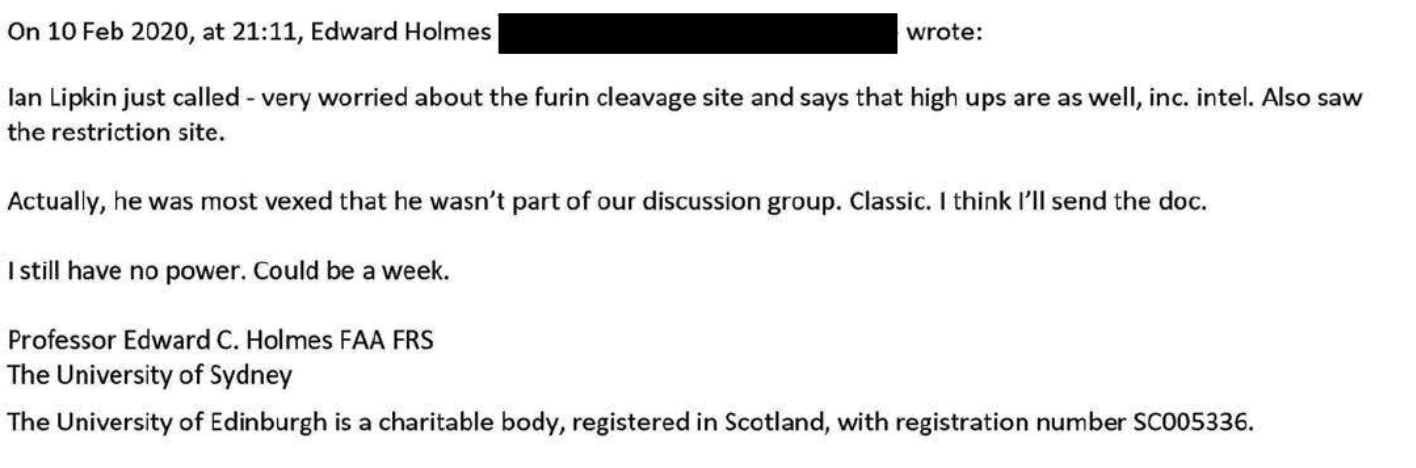
In an email on March 3, he told DCNF that he believes the furin cleavage site does not constitute evidence the virus is engineered.
“What we can rule out is a deliberate design because the furin cleavage site is only one of the features that made this virus so infectious and virulent,” he said.
Lipkin maintains a natural origin is more likely.
“We will never know the origin of the virus because samples and data were not collected appropriately,” he said to DCNF. “The market hypothesis is the most plausible given that thousands of wild animals were sold in the market before the pandemic and abundant viral sequences were detected in swabs of stalls where animals were kept.”
Lipkin has served as a scientific advisor to the intelligence community and discussed the origin question with several intelligence agencies, according to a congressional transcribed interview he gave in April 2023.
All content created by the Daily Caller News Foundation, an independent and nonpartisan newswire service, is available without charge to any legitimate news publisher that can provide a large audience. All republished articles must include our logo, our reporter’s byline and their DCNF affiliation. For any questions about our guidelines or partnering with us, please contact [email protected].
Bypass Big Tech Censors
Two Storms, One Harvest

Every food crisis in living memory has been a one-shock event. The 2008 price spike was a commodity bubble. The 2020 shortages were a logistics failure. The 2022 grain scare was a war on one exporter’s ports. Each time, the system bent, adjusted, and recovered, and each time the experts assured us afterward that global markets are simply too big and too diversified to fail.
What nobody in Washington seems eager to discuss is that 2026 is shaping up to be something the modern food system has never actually faced. Two independent shocks, one climatic and one geopolitical, are converging on the same harvest cycle at the same time. Not sequentially. Simultaneously.
Start with the weather. The Pacific Ocean is currently building toward what forecasters now openly call a record event. NOAA’s Climate Prediction Center puts the odds of at least a strong El Niño near 88 percent, with roughly two in three odds it reaches “very strong” status, the tier reserved for perhaps three or four events in the entire satellite era. Every major global model now projects a median peak in Super El Niño territory, and most of them project it exceeding the 2015-16 event, which until now held the modern record. Sea surface anomalies were already brushing the super threshold in mid-July, months before these events normally peak. The atmosphere has already shifted into El Niño mode, and the event is forecast to crest in late fall and early winter.
This is not about “climate change.” It’s about the standard cycles of weather, and the cycle we’re currently in is one that has likely devastated societies in the past. We’re better prepared as a society today, but not all Americans are equally prepared.
Serious households have started doing the quiet math on their own. Grocery bills tell part of the story, and the forecast maps tell the rest, which is why long-term food storage has moved from fringe hobby to mainstream line item in the family budget, with established suppliers like Heaven’s Harvest seeing demand from people who five years ago would have rolled their eyes at the idea. That instinct is not paranoia. It is pattern recognition, and the pattern is worth walking through carefully.
Editor’s Note: Heaven’s Harvest IS a sponsor, but the warnings of this article are real and would be written even if we didn’t have a survival food sponsor. With that said, those who take advantage of what they offer can use promo code “Patriot” for 15% off.
The Fertilizer Clock Is Already Running
While the Pacific warms, the second shock has been unfolding in the Strait of Hormuz. The conflict with Iran turned the world’s most important energy chokepoint into a contested waterway, and the consequences reach far beyond the gas pump. Roughly a third of global fertilizer trade moves through Hormuz, and the disruption sent urea prices up 86 percent year over year by March, with a 53 percent jump in a single month.
The World Bank projects energy prices rising about 24 percent in 2026 and fertilizer about 31 percent. By its own accounting, fertilizer prices ran 35 percent higher in the first five months of this year than the same period last year.
Here is the mechanism the nightly news will not explain. Fertilizer is not a grocery item. It is a time-delayed input. The nitrogen a farmer in Iowa or Punjab could not afford to apply this spring does not show up as a problem this spring. It shows up as a thinner harvest six to twelve months later.
The World Bank’s own food security brief concedes that the effects of reduced applications earlier this season “are likely to become visible only later in harvest outcomes.” Translate that from institutional language into plain English and it means this. The damage is already done, it is already in the ground, and we are simply waiting for it to arrive on the shelf.
Now check the calendar. Six to twelve months from the spring planting season lands us squarely in late 2026 and early 2027. Which is precisely when the strongest El Niño in the instrumental record is forecast to peak, bringing its signature droughts to Southeast Asia, Australia, southern Africa, northern Brazil, and South Asia, the very regions that grow the world’s rice, sugar, and oilseeds.
The World Bank warns openly that a strong El Niño “could disrupt multiple crop belts simultaneously” on top of the conflict-driven input costs. Their baseline projection assumes the Middle East disruptions ease by autumn. What in the last two years of Middle East history suggests that assumption is safe?
The System Has No Slack Left
The comfortable answer is that global markets always adjust. But adjustment requires slack, and the slack is gone. Global cereal production is expected to decline from last year’s records even before El Niño does its work. The UN World Food Programme, hardly a den of right-wing preppers, is calling this the most significant disruption to its supply chains since Covid and the invasion of Ukraine, and its supply chain director put the stakes bluntly.
Today’s supply chain challenges are tomorrow’s hunger crisis.
There is also a political dimension that markets cannot price. When food gets scarce, governments do not behave like economists. They behave like politicians. Export bans, hoarding mandates, and panic buying at the national level turned the modest rice shortfall of 2008 into a global crisis, and analysts are already warning that import-dependent nations are the first dominoes.
The 2015-16 Super El Niño, a far weaker event than what is now forecast, threw tens of millions into food stress across Africa and Asia. This one is projected to be stronger, and it arrives with fertilizer already rationed by price and shipping lanes already contested by missiles.
What Joseph Knew
Scripture does not treat preparation for lean years as faithlessness. It treats it as wisdom delivered in advance to those willing to act on it.
Behold, there come seven years of great plenty throughout all the land of Egypt: And there shall arise after them seven years of famine; and all the plenty shall be forgotten in the land of Egypt.
Joseph did not respond to that warning with a hashtag or a committee. He stored grain during the years of abundance, and when the famine came, Egypt stood while its neighbors begged. The lesson is not that famine is certain. It is that the time to prepare is precisely when preparation still looks optional.
Nobody who filled a pantry in a year of plenty has ever regretted it, and nobody standing in an empty aisle has ever been glad he waited for certainty.
None of this calls for panic, and panic is the enemy of sound judgment anyway. It calls for the same unglamorous prudence our grandparents considered ordinary. Keep some cash margin, know your local growers, and put real food in deep storage while it is cheap and available, because the entire arc of this story is that cheap and available is a closing window.
Families looking for a straightforward place to start can visit Heaven’s Harvest and use promo code Patriot for 15 percent off long-term storable food. The forecasts may yet soften, the strait may yet reopen, and we should pray they do. But hope is a fine thing to hold and a foolish thing to eat.