



(Zero Hedge)—In November, the entertainment media was energized by the news of potential studio mergers and a potential jump in content spending by Disney and Paramount. The possibility of more cash flowing into productions was seen as a light at the end of a long dark tunnel for a film industry crushed by endless box office and TV streaming failures. Maybe this new funding would revitalize a Hollywood gasping for oxygen?
However, as The Hollywood Reporter noted, the surge in funding was not necessarily going into the pockets of the current crop of filmmakers and TV series showrunners. Instead, Disney, Paramount and other entertainment conglomerates are shifting cash into sports and foreign content.
The reasons why media giants are quietly abandoning Hollywood should be obvious. In early 2025, these same companies took one last gamble on DEI and stood in solidarity with activist producers, directors and writers. And, the result this year was the same as the last several years: They lost billions in revenues.
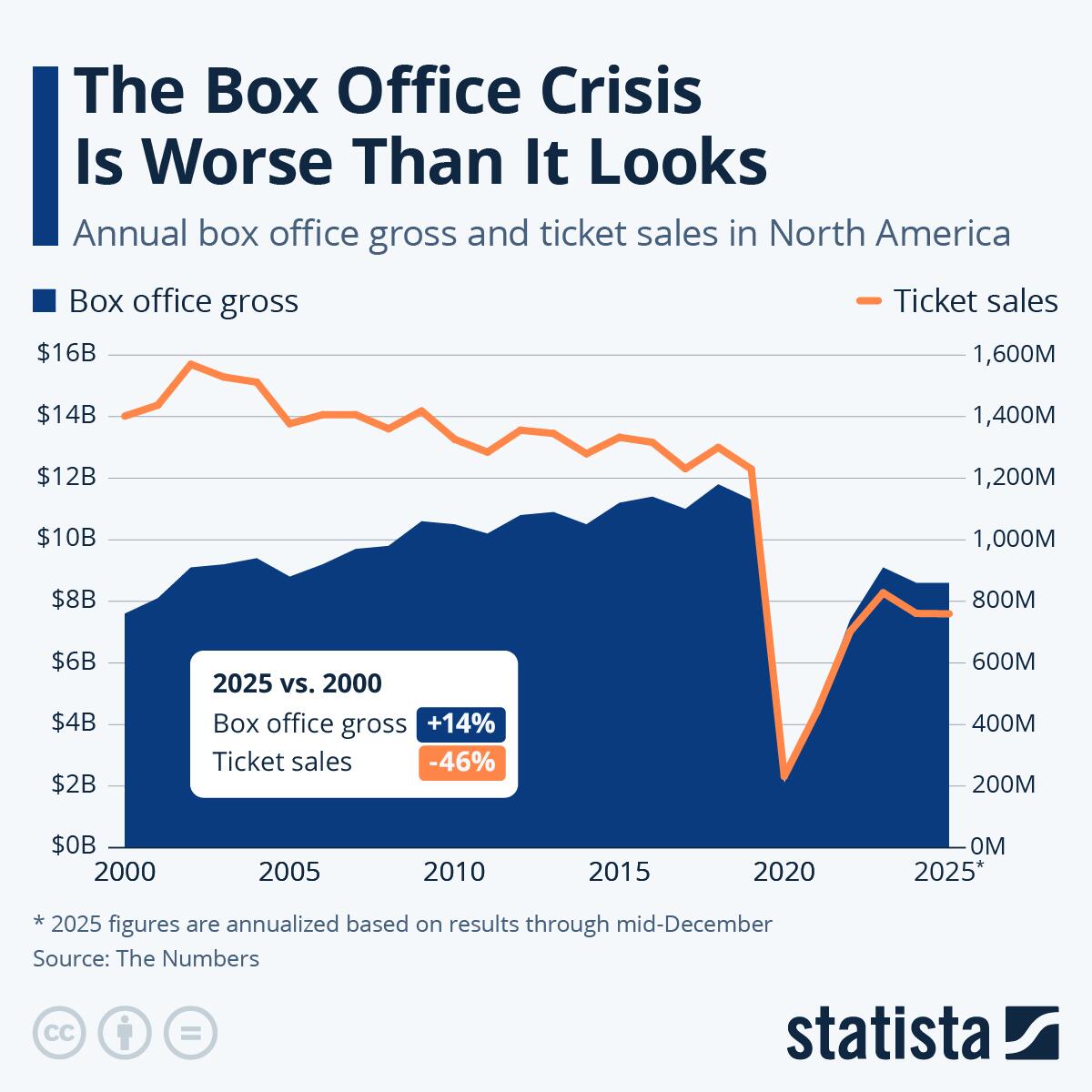
The raw box office numbers are ugly, but they don’t tell the whole story. Overall productions costs have skyrocketed by 25% since early 2020 and inflation in ticket prices has hidden the crippling plunge in total ticket sales compared to the same time period. In other words, Hollywood’s profit margins are shrinking while their audience is dwindling.
Their strategy in early 2025 revolved around the idea of attacking the audience (their customer base) as a “toxic fandom” that needs to be shamed and marginalized. The problem is, in most cases when companies go to war with their customers they inevitably lose.
More recent examples include Superman director James Gunn’s social media rants attacking fans for criticizing the pro-illegal immigration propaganda planted in the comic book film which was intended to relaunch the Warner Bros. DC universe. The media applauded Gunn’s handling of the fandom and claimed that he set a precedent for future films that draw audience backlash. In reality, Gunn’s movie was a box office flop, falling $100 million short of the $700 million in global ticket sales needed for the film to break even.
Gunn’s big mouth and far-left propaganda sunk the movie’s chances. Keep in mind, the Superman franchise is about as all-American as you can get; to not draw in a massive US audience requires stunning incompetence.
Then there was the epic failure of Disney’s Star Wars series, “The Acolyte”. The streaming series sought to deconstruct the Star Wars mythos by making the Jedi the villains and portrayed the Sith as misunderstood good guys. The show was saturated with LGBT casting and gay propaganda including the infamous lesbian space witches. The Acolyte was created by Leslye Headland, former assistant of Harvey Weinstein, and was essentially the last attempt by Lucasfilm President Kathleen Kennedy to force fans to embrace a woke version of the franchise.

To this day, Headland has been raging against “toxic” audiences for rejecting the series and making it one of the most embarrassing projects ever to be released by Disney’s streaming service (and there’s a long list of disastrous releases from Disney+). She asserts that her show’s dismal reception had nothing to do with bad writing and woke storytelling; rather, it was the fault of “racist and fascist” fans.
Disney immediately cancelled the show due to rock bottom viewership and it’s unlikely Headland will ever touch another Star Wars project again.
Even “Stranger Things”, a Netflix mainstay considered a sure winner, faced audience decline during its final season after planting abrupt and unnecessary LGBT messaging in the series. The establishment media came to the show’s defense, arguing that audiences have become “entitled” and that studios need to stop trying to give customers what they want.
The truth is, Hollywood has been ignoring audience feedback for years and their concerns have focused more on force-feeding fans a steady diet of woke indoctrination. This might have been possible for them a few years ago when cash reserves were still strong, but the studios are finally realizing that they can’t propagandize the public if no one pays to watch their garbage.
In other words, the leftists in entertainment didn’t take into account the possibility that audiences would simply walk away. They can control every facet of media from TV to advertising to film, but they can’t force people to consume their content (at least not in the US).
And this seems to be the new business model for Hollywood going into next year. 2025 was the last hurrah for woke programming in America. Now, studios are scrambling to cancel a number of politically charged shows and movies in the hopes of finally bringing profits back to their pre-pandemic glory. Their pending 2026 release lineup, though, is anorexic.

In the meantime, companies like Netflix are adapting with targeted woke messaging in countries where people can actually be forced to watch. In Britain, for example, the government is excitedly promoting the Netflix series “Adolescence”. The show is set to be featured in UK classrooms as part of an anti-masculinity program to brainwash young men into avoiding conservative content and fearing their own biology.
It is likely that the industry will try to adapt their productions to markets where audiences have less freedom of choice in the hopes of offsetting their losses in the US, but the fact remains that unless they abandon woke politics completely there is little chance that they will be able to weather another year of failure similar to the ugliness of 2025.
Bypass Big Tech Censors
Starting the Day With a Scripture-Inspired Roast Helps Center Your Thoughts on Eternal Truths Amid Temporal Pressures
The world can seem chaotic, especially right after we wake up. Many believers start their mornings reaching for something familiar — a hot cup of coffee — yet end up settling for mediocre brews that do little more than deliver a caffeine jolt. The daily grind of life, with its endless distractions, news cycles, and responsibilities, can leave even the most faithful feeling spiritually parched alongside their physical fatigue. What if your morning ritual could do more than wake you up? What if it could ground you in truth, nourish your body with exceptional quality, and quietly advance a kingdom purpose at the same time?
That’s the promise — and the reality — behind Promised Grounds Coffee. This Christian-founded company doesn’t just roast beans; it approaches every step as an act of worship and discipleship. By selecting only the top 10% of specialty-grade beans, ethically sourced from dedicated farmers in Central and South America, and small-batch roasting them with reverence in Austin, Texas, Promised Grounds delivers what many describe as the best coffee available — never burnt, never bland, but rich with origin stories and layered flavors that honor God’s creation.
From the vibrant Psalm 27 Roast (a light, bright medium option) to the bold yet peaceful 2 Timothy 1:7 Decaf, each bag carries a Scripture verse that turns your daily pour into a gentle reminder of faith. And through their Ounce Per Ounce Promise, every ounce of coffee you enjoy provides an equal ounce of clean water to families in need via partnership with Filter of Hope — literally brewing hope for body and soul, one cup at a time.
The challenge for today’s Christians runs deeper than finding a decent cup. In an age of convenience-driven consumerism, it’s easy to support companies that dilute values or remain silent on matters of faith. Many believers want their everyday choices — from what they drink to how they spend — to reflect discipleship rather than just convenience. Promised Grounds solves this by weaving Christian excellence into the entire process: beans nurtured with prayerful stewardship by farming families, roasted as an offering rather than a commodity, and packaged with Bible verses to encourage a mindset of gratitude and purpose from the first sip. Reviewers consistently praise the smooth, rich profiles — whether enjoyed black in a drip maker, iced on a warm day, or shared in fellowship — noting how the quality stands toe-to-toe with premium secular brands while delivering something far more meaningful.
This integration of faith and flavor addresses a real need in Christian households and ministries. Busy parents, church leaders, and remote workers alike report that starting the day with a Scripture-inspired roast helps center their thoughts on eternal truths amid temporal pressures. The coffee’s exceptional character — bright citrus notes in lighter roasts or deep chocolate undertones in bolder ones — comes from meticulous selection and careful roasting that respects the bean’s natural gifts rather than masking them. It’s the kind of coffee that elevates a simple quiet time, fuels productive workdays, or sparks meaningful conversations when shared at Bible studies or outreach events. And because it’s ethically sourced with integrity, every purchase supports sustainable livelihoods for farmers who treat their crops like family harvests.
For those leading churches or small groups, the impact multiplies. Promised Grounds offers bundles and options perfect for hospitality ministries, turning ordinary coffee service into an opportunity to point people toward the living water of Christ. Imagine greeting visitors with a warm cup whose very bag carries God’s Word — a subtle yet powerful witness that aligns with the Great Commission. The company’s Texas roots and commitment to “brewing hope” resonate especially with believers who value American enterprise paired with global compassion.
Of course, quality alone isn’t enough if the experience feels out of reach. Promised Grounds keeps it accessible with practical perks like free shipping on orders over $40, sample sets for discovering favorites, and thoughtful add-ons such as faith-themed mugs. Whether you prefer whole beans for fresh grinding, grounds for convenience, or even bulk options for larger households and ministries, the result is consistently superior coffee that makes discipleship feel integrated rather than added on.
As you consider how to align even the smallest habits with your walk with God, Promised Grounds Coffee stands out as a refreshing solution. It tackles the dual problems of subpar daily sustenance and disconnected consumption by offering a product that genuinely excels in taste while advancing a mission of clean water, farmer dignity, and scriptural encouragement. Believers who make the switch often describe it as more than a beverage upgrade — it becomes part of their rhythm of gratitude, a daily invitation to remember that every good gift comes from above.
If you’re ready to transform your mornings (and perhaps your church gatherings) with coffee that honors both exceptional craftsmanship and Christian values, I encourage you to explore what Promised Grounds has to offer. One sip at a time, you’ll be nourishing your body, refreshing your spirit, and participating in something far greater — all while enjoying what truly is among the best coffee available.