



(The Epoch Times)—His vetoes, his foreign trips, his upcoming debate with Florida Gov. Ron DeSantis: It all adds up to something like a shadow presidential campaign by California Gov. Gavin Newsom.
It’s hard to predict how Mr. Newsom might pull it off, at least during this cycle—he has remained a steadfast supporter of incumbent President Joe Biden, and as the filing deadlines for multiple Democratic primaries have passed, he hasn’t flinched.
He could be gunning for 2028, two years after state term limits will force him out of the governor’s mansion. Or, if events line up just right, he could make his move sooner.
“I think it’s been pretty obvious that Newsom has been positioning himself for a run in 2028 and to be available in 2024 should Biden’s health or capacities deteriorate to the point that Democrats decide that they need another candidate,” Morris Fiorina, professor of political science and Hoover Institution fellow at Stanford University, told The Epoch Times.
California Assemblyman James Gallagher, who leads the Republicans in that chamber of the California Legislature, also cast doubt on President Biden’s ability to campaign for another term.
“Right now, everybody in public is saying they’re rallying behind Joe Biden, but it’s very clear that he is deteriorating,” Mr. Gallagher told The Epoch Times.
Gloria Romero, a Democrat who was formerly majority leader of the California State Senate, said “the conundrum is the vice president,” and dubbed Mr. Newsom “the replacement candidate.”

2024 as 1968
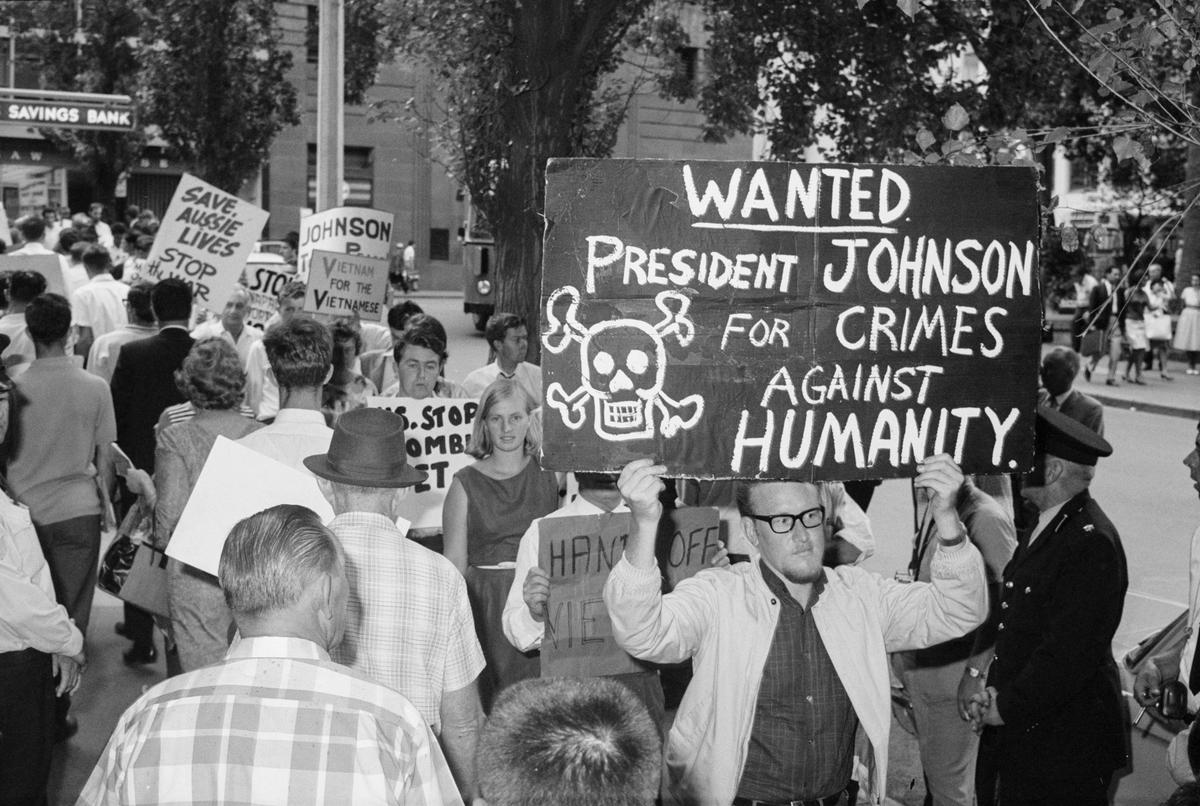
President Biden’s detractors have sometimes compared him to former President Jimmy Carter, who presided over high inflation and his own hostage crisis. But an even more war-clouded incumbent—Capitol Hill dealmaker President Lyndon B. Johnson—could offer another parallel as the United States steps up support for Israel against Hamas. Like the Vietnam War, the conflict is unpopular with much of the Democrats’ base, in part because of civilian casualties.

Amid protests over Vietnam, the unpopular President Johnson dropped out of the race early in 1968. Months of intraparty division, including the assassination of presidential candidate Robert F. Kennedy, culminated in the chaotic and violent Democratic convention, which was held in August in Chicago.
The party establishment’s favorite, then-Vice President Hubert Humphrey, ultimately carried off the nomination, defeating a fellow Minnesotan, the anti-war Sen. Eugene McCarthy (D-Minn.), and various others. Mr. Humphrey then fell in the general election to Richard Nixon, the man who was once counted out of national politics after he lost the 1960 presidential race to John F. Kennedy.
There are other striking similarities between 2024 and 1968. The Democratic National Convention will again take place in Chicago. Robert F. Kennedy’s son is in the running, too, albeit as an independent. And President Biden’s new Democratic primary challenger, Rep. Dean Phillips (D-Minn.), is, like Mr. Humphrey and Mr. McCarthy, a Minnesotan (though, unlike them, he isn’t running against an unpopular war).
Chuck DeVore, a former California State Assembly member now with the Texas Public Policy Foundation, told The Epoch Times that President Johnson’s departure from the field “opened up the delegates that he may have already won at that point to be able to vote as they pleased on the floor of the Democratic convention.”
“Essentially, you end up with this brokered convention. We may end up seeing something very similar in 2024,” he said.
Seeking the Center on Domestic Issues
The 2024 Chicago convention is many months away. For now, an observer can only assess what California’s governor has already done that may boost his presidential profile.

During the last legislative session, some of Mr. Newsom’s vetoes attracted media attention. For instance, he shot down legislation that would have decriminalized possession of psychedelic mushrooms. He also vetoed a bill that would have seen condoms distributed for free in California’s public high schools as well as legislation that would have altered child custody proceedings by making judges favor parents who “affirm” a minor’s transgender identity.
In a CNN opinion piece, liberal commentator Jill Filipovic called some of those vetoes “disappointing,” arguing that the governor is “a man who puts his own political future ahead of the will of the people.”
While some observers may sense a shift to the center, Ms. Romero doesn’t quite see it that way.
“It’s really political calculation,” she said. She lambasted some of the bills emanating from California’s Legislature, calling them “almost Babylon Bee-ish.” They are, in short, hard for the governor to greenlight if he wants to become competitive across a country where California values aren’t always and everywhere welcome.
She speculated that some of the vetoes show the governor trying to regain the trust of nonleftist Democrats like her, many of whom have become disillusioned with Mr. Newsom’s leadership style.
Ms. Romero described California’s leader as a chameleon-like figure who benefits from a relatively sympathetic treatment by the legacy media.
Like Ms. Romero, Mr. Gallagher characterized the vetoes as a political maneuver meant to make the governor seem less left-wing.

“The problem is, he’s still passing pretty radical policy,” Mr. Gallagher said. He cited bills such as Democratic state Sen. Scott Wiener’s S.B. 253, which will require large companies to report greenhouse gas emissions.
He said Mr. Newsom’s vetoes may allow him to look tougher on drugs while preserving his environmental agenda—a signature issue for him domestically and during his recent trip to China, where climate policy was a central concern.
Vetoes by the Numbers
Mr. DeVore suggested the vetoes may be less exceptional than they seem.
“Every governor of California, or really any governor across the country, will veto a certain number of bills that they see as just poor bills,” he said.
“I think there is a danger in reading a little too much into that,” he added, noting that the state’s past Democratic governors have also vetoed bills from the Legislature, which has skewed left for many decades.

Indeed, while some media coverage suggests Mr. Newsom’s recent vetoes take him closer to the American center, the big picture is foggier.
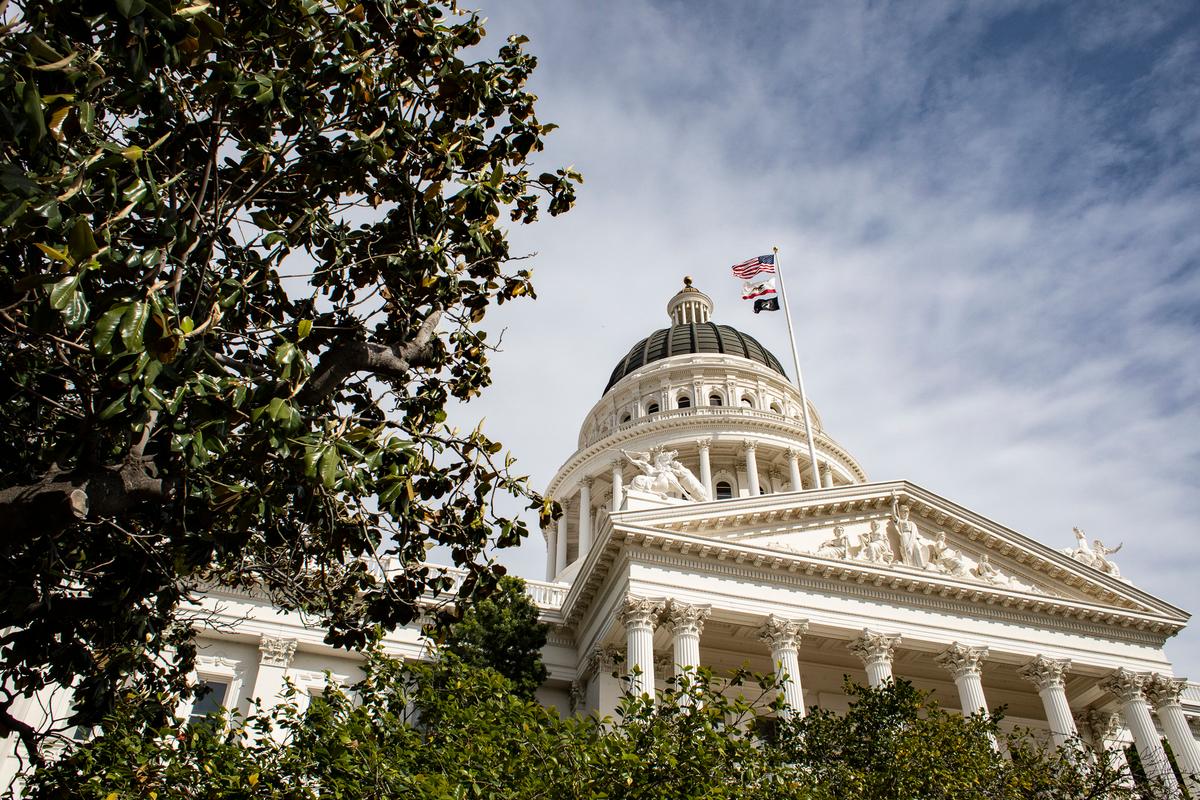
Mr. Newsom vetoed 156 bills and signed 890 bills during the latest legislative session. That means he shot down a little less than 15 percent of the legislation that reached him from the state’s Legislature, both chambers of which are controlled by commanding Democratic supermajorities.
That’s in keeping with what he has done before, according to an analysis by the California Senate’s Office of Research.
Mr. Newsom vetoed a little fewer than 14.5 percent of the bills that reached him in 2022. While that marked a big increase over a 7.89 percent veto rate in 2021, it was roughly on par with a 13.08 percent veto rate in 2020—and in 2019, the governor vetoed 16.51 percent of the bills that crossed his desk, a higher rate than in 2023.
Mr. Newsom’s immediate predecessor, fellow Democrat Gov. Jerry Brown, vetoed a similar share of bills during his second stint as governor. The veto percentage under his leadership ranged from a low of 10.71 percent in 2013 to a high of 16.52 percent in 2018.
The last California governor who consistently vetoed a bigger chunk of bills was its last Republican state executive, Arnold Schwarzenegger. The movie star-turned-politician took down more than 22 percent of the bills that passed the Legislature every year he was in office. He wielded his veto pen most frequently in 2008, nixing 35 percent of the legislation that session.

Mr. Fiorina of the Hoover Institution argued that Mr. Newsom’s vetoes are just part of the picture when it comes to his supposed conservative turn.
In September, for example, the governor announced the Board of State and Community Corrections was awarding over $267 million to law enforcement agencies across California.
“He made extra funds available to local authorities for crime fighting,” Mr. Fiorina said.
In addition, the governor has launched the CARE Court program for mental illness treatment, which withstood disability rights activists’ legal challenge in the California Supreme Court. Mental illness is one of the chief contributors to homelessness, a formidable challenge in Mr. Newsom’s state.
“Crime, homelessness, trans issues … it is almost as if his staff is thinking, ‘What attack ads about [California] liberals will the Republicans run in the Midwest battlegrounds? Let’s move now to head them off,” Mr. Fiorina said.
Ms. Romero, the California Democrat, said she expects Mr. Newsom to “dance to the latest tune of the piper, even as silly as they might be, to basically become the new head of the Democratic Party.”
Newsom in China
The same President Nixon who in 1968 defeated Mr. Humphrey went on to visit China while in office. The president, a poker shark during his youth, played his hand boldly but carefully at a time when the Soviet Union and China were fracturing.
The trip, which helped set the stage for the end of the Cold War, was so iconic that it even inspired an opera, John Coolidge Adams’s “Nixon in China.” (“Five-card stud taught me a lot about mankind,” the President Nixon character muses in the third act.)
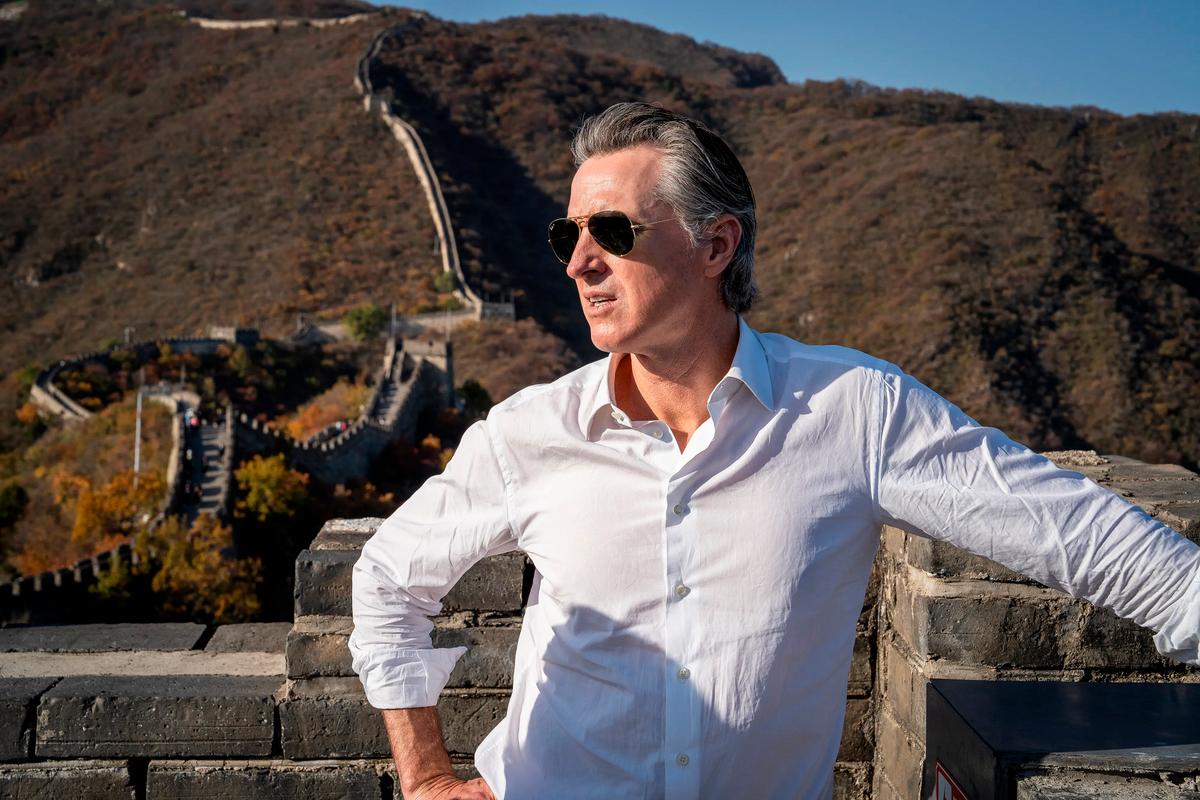
Mr. Newsom’s Chinese tour hasn’t yet been commemorated in song, at least. But a few photos and videos of his trip, part of foreign travels that also saw him visiting Israel, have circulated widely on social media, sometimes amplified by accounts unfriendly to the governor and his party.
There’s Mr. Newsom, posing in sunglasses on the Great Wall of China. There’s Mr. Newsom, tooling around in a Chinese electric vehicle. There’s Mr. Newsom, barreling into a small Chinese boy on a basketball court. For the media-savvy man at the head of America’s most image-conscious state, the optics may have smarted.
The substance of the governor’s trip has also come under scrutiny.
The Daily Caller News Foundation reported that an affiliate of a Chinese intelligence service took credit for bringing Mr. Newsom to China.
The Epoch Times has reviewed Chinese-language posts from that group, the Chinese People’s Association for Friendship with Foreign Countries, which the State Department in 2020 said was seeking “to directly and malignly influence state and local leaders to promote the PRC’s global agenda.”
In one post, the organization’s president, Yang Wanming, lauded California, saying it was “at the forefront” of U.S. states when it comes to relations between China and America, having what it called “close personnel exchanges.”
Mr. Newsom did not discuss China’s human rights record with Chinese leader Xi Jinping, though a statement from the governor’s office claimed he discussed “a variety of human rights issues including Hong Kong, Tibet, Xinjiang and Taiwan” with other officials.
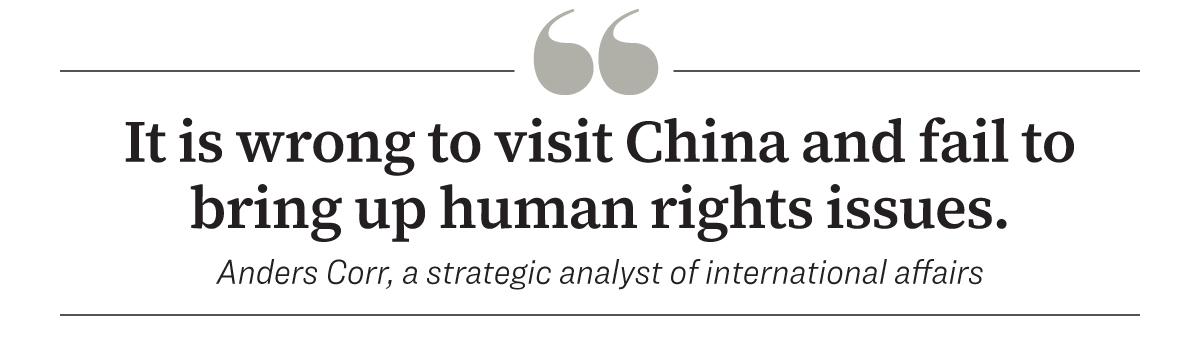
“It is wrong to visit China and fail to bring up human rights issues. But Newsom went further, defending his failure,” said Anders Corr, a strategic analyst of international affairs, in an email to The Epoch Times.
“The visit raises questions about why an American politician—who doubtless seeks the presidency—would do such damage to his own reputation,” Mr. Corr, who is also a contributor to the publication, added.
Mr. Gallagher pointed out that the governor’s time coincided with a flyover by a Chinese jet of a U.S. bomber. And only days ago, a federal prosecutor alerted the House Judiciary Committee of possible Chinese Communist Party (CCP) interference in the state’s 2024 election.

“While he’s back there, we have continued interference and aggression from China, and Gavin’s just buddying up to them,” he said.
The California State Assembly’s Republican leader questioned the governor’s comments lauding the country’s record on climate and the environment.
“He certainly is coming back really more singing China’s praises rather than standing up to them and the clear abuses that they have on human rights and intellectual property theft,” he said.
The trip garnered plenty of media attention, fueling more speculation about the governor’s possible ambitions for higher office. Yet both Mr. DeVore and Ms. Romero pointed out that such visits to China and other Asian countries aren’t so unusual for California leaders.
“This is not an unusual thing, for a California governor to be on the world stage,” Mr. DeVore said.
“California has a unique relationship with the Pacific Rim, and so it’s not unusual for delegations to go to Asia,” Ms. Romero said.
She was particularly critical of his stumble while playing basketball.
“Politics is a sport. There he is, playing a sport, and he literally trips over and falls,” Ms. Romero said.
Newsom Versus Harris
As he builds toward a possible bid for the White House, Mr. Newsom has to go beyond establishing his credibility on domestic and foreign affairs. He must somehow gingerly skirt around the woman now second in line for the most powerful office on the planet, Vice President Kamala Harris.
In an appearance on NBC’s “Meet the Press” in September, Mr. Newsom said Ms. Harris “is naturally the one lined up” if President Biden does not run.
The two go way back in California, and more specifically in San Francisco politics, having scored early wins in the same city that produced former House Majority Leader Nancy Pelosi (D-Calif.). Ms. Harris was San Francisco’s district attorney while Mr. Newsom served as that city’s mayor. In fact, according to local reporting from the time, Mr. Newsom was in the crowd during Ms. Harris’s swearing-in ceremony in 2004, the same day he was sworn in as mayor.
Ms. Romero suggested the Democrats may have to execute a delicate maneuver: “How do we replace her without being accused of being racist, sexist, blah blah blah?”
Mr. Gallagher agreed with Mr. Newsom that the “likely” replacement for President Biden, should he bow out, would be Ms. Harris, who is half Jamaican and half East Indian by origin.
While the daughter of two professors checks the right boxes for intersectional realpolitik, the vice president has been dogged by low likability and high unlikability ratings in many surveys. But slotting in Mr. Newsom could be tricky for multiple reasons.
“You would have to overstep her to get in that place. And if he does, then they’re going to have a problem with black voters, a core part of their voting constituency,” he said.
Indeed, black turnout fell in the 2016 election, when Hillary Clinton ran as the Democratic candidate after eight years of President Barack Obama, whose ancestry is half Kenyan and half white American.
But California’s white governor may have played his party’s intersectional (and coalitional) politics adeptly by appointing now-Sen. Laphonza Butler to take over for the late Sen. Dianne Feinstein.
In addition to being an LGBT black woman, Ms. Butler was a leader in the Service Employers International Union (SEIU), a major force for Democrats during elections. She also led the pro-abortion access group EMILY’s List.

“She brought with her two vital constituencies for the modern Democratic Party,” Mr. DeVore said.
Ms. Butler has also announced she won’t seek reelection. That leaves a lane open for Rep. Adam Schiff (D-Calif.), beloved among many Democrats for his role in President Trump’s first impeachment.
Newsom Versus DeSantis (and Trump)
Like Ms. Romero and Mr. Gallagher, Mr. DeVore suggested Mr. Newsom would have a tough time bypassing Ms. Harris even with the presidency on the line.
“How do they finesse being able to minimize the time where Biden is a lame duck [and] somehow figure out how to muscle Kamala Harris aside and have a reset at getting a person in as a standard bearer who has a better shot at winning? This is not an easy thing to do,” he said.
Some of the credibility to pull it off may come from the California governor’s upcoming debate with Mr. DeSantis, another White House hopeful.
Mr. Newsom mocked Mr. DeSantis for accepting his invitation to debate. The two will go at it on Fox News host Sean Hannity’s program on Nov. 30.
“The fact that he took the bait in relation to this debate shows that he’s completely unqualified to be president of the United States,” Mr. Newsom said in a September interview coinciding with the second Republican debate in Simi Valley, California.
The governor dominated the Reagan Library’s spin room for portions of that event, helping to define the media’s interpretation of it.
Florida’s governor has seized on Mr. Newsom’s China visit to get in his own digs, comparing Mr. Newsom to Mr. Xi.
“These are two guys who locked down their people, violated their rights … imposed medical authoritarianism, and really hurt their societies—and they both had really the same playbook on COVID-19,” Mr. DeSantis said on Fox & Friends during Mr. Newsom’s trip.
Mr. Gallagher said, “I predict Gavin will get destroyed by DeSantis because Gavin has no record to stand by.”
For some Americans now wondering if Mr. Newsom has what it takes to be president, the matchup could prove educational. If not, it could at least be entertaining. It’s being billed a little like a pro-wrestling showdown.
Other Americans may reserve their judgement until the California governor faces off against the Republican frontrunner, President Trump.
Unlike Mr. Newsom, Mr. DeSantis, or Ms. Harris, President Trump has occupied both the White House and World Wrestling Entertainment’s WrestleMania ring.
Mr. Newsom has never duked it out with WWE promoter Vince McMahon, but he can talk the right kind of trash for modern American politics. In April, he predicted that Mr. DeSantis would “get rolled by Trump.”
Eva Fu contributed to this report.
Bypass Big Tech Censors
Starting the Day With a Scripture-Inspired Roast Helps Center Your Thoughts on Eternal Truths Amid Temporal Pressures
The world can seem chaotic, especially right after we wake up. Many believers start their mornings reaching for something familiar — a hot cup of coffee — yet end up settling for mediocre brews that do little more than deliver a caffeine jolt. The daily grind of life, with its endless distractions, news cycles, and responsibilities, can leave even the most faithful feeling spiritually parched alongside their physical fatigue. What if your morning ritual could do more than wake you up? What if it could ground you in truth, nourish your body with exceptional quality, and quietly advance a kingdom purpose at the same time?
That’s the promise — and the reality — behind Promised Grounds Coffee. This Christian-founded company doesn’t just roast beans; it approaches every step as an act of worship and discipleship. By selecting only the top 10% of specialty-grade beans, ethically sourced from dedicated farmers in Central and South America, and small-batch roasting them with reverence in Austin, Texas, Promised Grounds delivers what many describe as the best coffee available — never burnt, never bland, but rich with origin stories and layered flavors that honor God’s creation.
From the vibrant Psalm 27 Roast (a light, bright medium option) to the bold yet peaceful 2 Timothy 1:7 Decaf, each bag carries a Scripture verse that turns your daily pour into a gentle reminder of faith. And through their Ounce Per Ounce Promise, every ounce of coffee you enjoy provides an equal ounce of clean water to families in need via partnership with Filter of Hope — literally brewing hope for body and soul, one cup at a time.
The challenge for today’s Christians runs deeper than finding a decent cup. In an age of convenience-driven consumerism, it’s easy to support companies that dilute values or remain silent on matters of faith. Many believers want their everyday choices — from what they drink to how they spend — to reflect discipleship rather than just convenience. Promised Grounds solves this by weaving Christian excellence into the entire process: beans nurtured with prayerful stewardship by farming families, roasted as an offering rather than a commodity, and packaged with Bible verses to encourage a mindset of gratitude and purpose from the first sip. Reviewers consistently praise the smooth, rich profiles — whether enjoyed black in a drip maker, iced on a warm day, or shared in fellowship — noting how the quality stands toe-to-toe with premium secular brands while delivering something far more meaningful.
This integration of faith and flavor addresses a real need in Christian households and ministries. Busy parents, church leaders, and remote workers alike report that starting the day with a Scripture-inspired roast helps center their thoughts on eternal truths amid temporal pressures. The coffee’s exceptional character — bright citrus notes in lighter roasts or deep chocolate undertones in bolder ones — comes from meticulous selection and careful roasting that respects the bean’s natural gifts rather than masking them. It’s the kind of coffee that elevates a simple quiet time, fuels productive workdays, or sparks meaningful conversations when shared at Bible studies or outreach events. And because it’s ethically sourced with integrity, every purchase supports sustainable livelihoods for farmers who treat their crops like family harvests.
For those leading churches or small groups, the impact multiplies. Promised Grounds offers bundles and options perfect for hospitality ministries, turning ordinary coffee service into an opportunity to point people toward the living water of Christ. Imagine greeting visitors with a warm cup whose very bag carries God’s Word — a subtle yet powerful witness that aligns with the Great Commission. The company’s Texas roots and commitment to “brewing hope” resonate especially with believers who value American enterprise paired with global compassion.
Of course, quality alone isn’t enough if the experience feels out of reach. Promised Grounds keeps it accessible with practical perks like free shipping on orders over $40, sample sets for discovering favorites, and thoughtful add-ons such as faith-themed mugs. Whether you prefer whole beans for fresh grinding, grounds for convenience, or even bulk options for larger households and ministries, the result is consistently superior coffee that makes discipleship feel integrated rather than added on.
As you consider how to align even the smallest habits with your walk with God, Promised Grounds Coffee stands out as a refreshing solution. It tackles the dual problems of subpar daily sustenance and disconnected consumption by offering a product that genuinely excels in taste while advancing a mission of clean water, farmer dignity, and scriptural encouragement. Believers who make the switch often describe it as more than a beverage upgrade — it becomes part of their rhythm of gratitude, a daily invitation to remember that every good gift comes from above.
If you’re ready to transform your mornings (and perhaps your church gatherings) with coffee that honors both exceptional craftsmanship and Christian values, I encourage you to explore what Promised Grounds has to offer. One sip at a time, you’ll be nourishing your body, refreshing your spirit, and participating in something far greater — all while enjoying what truly is among the best coffee available.