



 (The Daily Caller News Foundation)—Top executives at Hong Kong-based WH Group Limited, the world’s largest pork producer that controls vast swaths of U.S. farmland through its American subsidiary, are Chinese Communist Party (CCP) members, according to a Daily Caller News Foundation review of corporate records and state-run media reports.
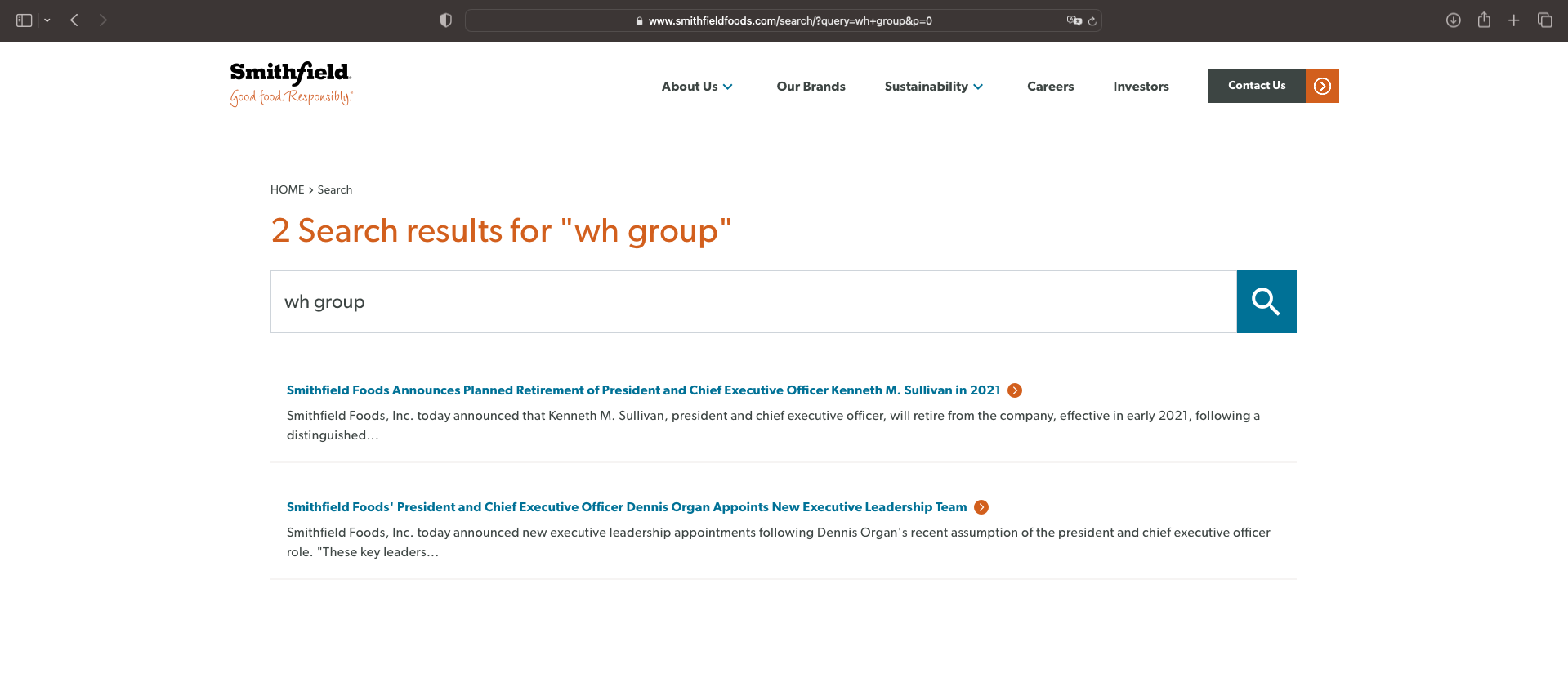
Records and reports reviewed by the DCNF identify four top executives and the chairman of the pork giant as CCP members with extensive ties to the Chinese government. WH Group controls nearly 150,000 acres of land across 29 U.S. states through its subsidiary Smithfield Foods, a family-run business established in 1936, which it purchased for $7.1 billion in 2013. While a keyword search on Smithfield’s website returned only two articles mentioning the firm’s relationship with WH Group, neither of the two articles mentioned China. An online map of Smithfield’s global business activities does not list any operations in, or connection to, Asia, despite archived reports from their website suggesting otherwise.
Revelations about WH Group’s CCP and Chinese government ties, which the DCNF found by cross-referencing the firm’s roster with Chinese-language news reports and corporate records, come as Republicans push for bans on Chinese rural land purchases, in particular, those close to U.S. military bases.
“It is no joke to join the Chinese Communist Party,” Matt Shoemaker, a former Defense Intelligence Agency officer, told the DCNF. “You cannot just walk in and sign-up. You have to show that you are a true believer.”
Several states, including Florida, have taken legislative and executive action to ban Chinese ownership of U.S. farmland. Recently, Missouri Gov. Mike Parson issued an executive order banning such purchases near military installations. GOP lawmakers also recently pressed the Biden administration to launch an investigation into the second-largest foreign owner of U.S. land after his CCP membership came to light.
“No foreign government should be owning American farmland,” said Shoemaker, who is running for Congress in North Carolina as a Republican. “It is a national security issue, for obvious reasons.”
WH Group’s chairman, Wan Long, as well as multiple board members and some senior management were identified as CCP members in a 2022 Chinese-language stock exchange filing from a subsidiary called Shuanghui Investment and Development Co. (SIDC). WH Group and Chinese corporate records from SIDC also show that WH Group’s chairman and several top executives hold, or previously held, Chinese government positions.
Between 2010 and 2021, the amount of U.S. land owned by Chinese entities skyrocketed from 13,730 acres to 383,935 acres, according to USDA reports.

Smithfield operates half a dozen distribution centers, nearly 20 direct store delivery services, 36 feed mills, as well as more than 40 production plants and 2,400 farms across 29 U.S. states, according to the firm’s website. In total, WH Group owns 146,000 acres in the U.S., according to a 2018 report by the Economic Research Service of the U.S. Department of Agriculture (USDA).
“Smithfield Foods, Inc. holds a substantial market share in the U.S. pork industry, accounting for approximately 26% of the total market share,” according to trade publication Essential Protein Trade & Shipping News.
In a bygone era, GOP governors might have welcomed Chinese investment into rural industries and communities. Now, it’s become a major source of concern as relations between the U.S. and China continue to sour.
South Dakota Republican Gov. Kristi Noem told the DCNF her office has had “a lot of hard conversations” with Smithfield’s leadership, adding she now believes the company poses a national security threat.
“Any time it felt like we would have the opportunity to work together, it ended up not going as well as I hoped,” Noem said. “I think a lot of that has to do with the fact that Smithfield is owned by China.”
Smithfield did not respond to multiple requests for comment.

‘The CCP’s Long-Term Strategy’
WH Group Chairman Wan Long is among the company’s senior leadership who is a CCP member with Chinese government ties, a DCNF review of corporate business filings and Chinese state media reports found.
An archived business profile on SIDC’s website identifies Wan Long as a CCP member.
SIDC is “the largest animal protein company in Asia” and its products include “chilled fresh pork and packaged meat products,” according to Smithfield’s website.
The DCNF reviewed and carefully translated key sections of SIDC’s Chinese-language website, which contains extensive information about WH Group executives’ CCP and Chinese government ties that are absent from WH Group’s English-language website.
Born in 1940, Wan Long joined the People’s Liberation Army (PLA) at the age of 20 before entering China’s meat industry, according to Chinese state-run media outlet People’s Daily. Wan Long has since earned various Chinese government positions and state awards, his archived SIDC profile states.
Between 1998 and 2018, Wan Long served as a representative to the National People’s Congress, according to his archived SIDC profile. The National People’s Congress operates “under the leadership” of the CCP, and its officials are “invariably influential members of the CCP and leaders of major mass organizations,” according to the Congressional Executive Commission on China.
SIDC’s archived website also notes that Wan Long has received a “special allowance” from China’s State Council. This refers to a reward system created to “strengthen and improve the work of the Party’s intellectuals,” according to the state-run China News Service. The tax-free reward ranges from a monthly stipend of roughly $85 to an approximately $2,800 lump sum payment, according to China’s Ministry of Human Resources and Social Security. However, it is unclear if Wan Long still receives this government reward.
Wan Long also earned the honorific “senior political engineer” from the Chinese government, according to his archived SIDC profile. Senior political engineers are required to possess a “relatively systemic grasp of Marxism-Leninism, Mao Zedong Thought and Deng Xiaoping Theory,” according to the State Council’s State-Owned Assets Supervision and Administration Commission.
China’s United Front Work Department (UFWD) also named Wan Long as one of 100 “Outstanding Private Entrepreneurs In The 40 Years Of Reform And Opening-Up” in 2018, according to the All-China Federation Of Industry And Commerce, a UFWD subordinate agency that co-sponsored the award.
The UFWD engages in “influence activities and intelligence operations,” according to the House Select Committee on the CCP.
SIDC’s 2022 filing on the Shenzhen Stock Exchange also identifies three WH Group senior managers — Qiao Haili, Wang Yufen, Liu Songtao — and WH Group executive director Ma Xiangjie as CCP members. All four WH Group executives hold high-level positions at SIDC.
Ma Xiangjie was also elected to serve as a National People’s Congress delegate in Henan province, according to that government body’s website. Delegates are elected by “the People’s congresses at the provincial level as well as by the People’s Liberation Army,” according to the Congressional-Executive Commission on China.
A local branch of the All-China Federation Of Industry And Commerce named Ma Xiangjie as one of Henan province’s people of the year between 2019 and 2020, according to the UFWD-affiliate’s website.
Yet, it is unclear just how many CCP members WH Group employs.
SIDC, on the other hand, has employed hundreds, according to the Communist Party Member Network’s website, which is operated by the CCP’s Organization Department.
“In recent years, over 300 new Party members have been recruited, strengthening the Party’s troops,” reads SIDC’s Communist Party Member Network profile. “Currently, Shuanghui Development’s senior executives include 17 Party members, constituting 85% [of all senior executives]; six business department general managers are Party members; six Party members are among the seven management department directors; all project managers are Party members; and 47% of the firm’s mid-level cadre are Party members.”
‘Update CFIUS’
When WH Group purchased Smithfield in 2013, the acquisition “received clearance” from the Committee on Foreign Investment in the United States (CFIUS).
CFIUS reviews foreign investments into the U.S. on the grounds of national security, the Treasury Department website states. Multiple U.S. government agencies participate in the CFIUS process, including the Department of Justice, the Department of Defense and others, according to the Treasury Department, which is also involved in that process.

“We are pleased that this transaction has been cleared by CFIUS, and we thank the Committee for its careful attention to this review,” Smithfield’s CEO and president at the time, C. Larry Pope, said at the time, according to an SEC filing.
Over a decade later, House Republicans see CFIUS’ approval of WH Group’s purchase of Smithfield as a case study in why the body needs to be reformed.
“What we need to do is update CFIUS to ensure that it has jurisdiction over all foreign adversary land purchases, and to ensure that it has the ability to consider U.S. food security as a factor in assessing the potential risk of a transaction,” Wisconsin Republican Rep. Mike Gallagher, who chairs the House Select Committee on the CCP, told the DCNF.
Iowa Republican Rep. Ashley Hinson said the CCP has “nefariously exploited loopholes to buy U.S. land, so they can exert control over our food supply and undermine our national security.”
“This is all part of the CCP’s long-term strategy to hurt America and our interests — whether it’s garnering valuable U.S. military intelligence or interfering with our food supply chain,” Hinson told the DCNF. “We cannot allow another acre of U.S. land to get into the hands of the CCP.”
WH Group, SIDC, Wan Long and CFIUS did not respond to multiple requests for comment.
All content created by the Daily Caller News Foundation, an independent and nonpartisan newswire service, is available without charge to any legitimate news publisher that can provide a large audience. All republished articles must include our logo, our reporter’s byline and their DCNF affiliation. For any questions about our guidelines or partnering with us, please contact [email protected].
Bypass Big Tech Censors
Starting the Day With a Scripture-Inspired Roast Helps Center Your Thoughts on Eternal Truths Amid Temporal Pressures
The world can seem chaotic, especially right after we wake up. Many believers start their mornings reaching for something familiar — a hot cup of coffee — yet end up settling for mediocre brews that do little more than deliver a caffeine jolt. The daily grind of life, with its endless distractions, news cycles, and responsibilities, can leave even the most faithful feeling spiritually parched alongside their physical fatigue. What if your morning ritual could do more than wake you up? What if it could ground you in truth, nourish your body with exceptional quality, and quietly advance a kingdom purpose at the same time?
That’s the promise — and the reality — behind Promised Grounds Coffee. This Christian-founded company doesn’t just roast beans; it approaches every step as an act of worship and discipleship. By selecting only the top 10% of specialty-grade beans, ethically sourced from dedicated farmers in Central and South America, and small-batch roasting them with reverence in Austin, Texas, Promised Grounds delivers what many describe as the best coffee available — never burnt, never bland, but rich with origin stories and layered flavors that honor God’s creation.
From the vibrant Psalm 27 Roast (a light, bright medium option) to the bold yet peaceful 2 Timothy 1:7 Decaf, each bag carries a Scripture verse that turns your daily pour into a gentle reminder of faith. And through their Ounce Per Ounce Promise, every ounce of coffee you enjoy provides an equal ounce of clean water to families in need via partnership with Filter of Hope — literally brewing hope for body and soul, one cup at a time.
The challenge for today’s Christians runs deeper than finding a decent cup. In an age of convenience-driven consumerism, it’s easy to support companies that dilute values or remain silent on matters of faith. Many believers want their everyday choices — from what they drink to how they spend — to reflect discipleship rather than just convenience. Promised Grounds solves this by weaving Christian excellence into the entire process: beans nurtured with prayerful stewardship by farming families, roasted as an offering rather than a commodity, and packaged with Bible verses to encourage a mindset of gratitude and purpose from the first sip. Reviewers consistently praise the smooth, rich profiles — whether enjoyed black in a drip maker, iced on a warm day, or shared in fellowship — noting how the quality stands toe-to-toe with premium secular brands while delivering something far more meaningful.
This integration of faith and flavor addresses a real need in Christian households and ministries. Busy parents, church leaders, and remote workers alike report that starting the day with a Scripture-inspired roast helps center their thoughts on eternal truths amid temporal pressures. The coffee’s exceptional character — bright citrus notes in lighter roasts or deep chocolate undertones in bolder ones — comes from meticulous selection and careful roasting that respects the bean’s natural gifts rather than masking them. It’s the kind of coffee that elevates a simple quiet time, fuels productive workdays, or sparks meaningful conversations when shared at Bible studies or outreach events. And because it’s ethically sourced with integrity, every purchase supports sustainable livelihoods for farmers who treat their crops like family harvests.
For those leading churches or small groups, the impact multiplies. Promised Grounds offers bundles and options perfect for hospitality ministries, turning ordinary coffee service into an opportunity to point people toward the living water of Christ. Imagine greeting visitors with a warm cup whose very bag carries God’s Word — a subtle yet powerful witness that aligns with the Great Commission. The company’s Texas roots and commitment to “brewing hope” resonate especially with believers who value American enterprise paired with global compassion.
Of course, quality alone isn’t enough if the experience feels out of reach. Promised Grounds keeps it accessible with practical perks like free shipping on orders over $40, sample sets for discovering favorites, and thoughtful add-ons such as faith-themed mugs. Whether you prefer whole beans for fresh grinding, grounds for convenience, or even bulk options for larger households and ministries, the result is consistently superior coffee that makes discipleship feel integrated rather than added on.
As you consider how to align even the smallest habits with your walk with God, Promised Grounds Coffee stands out as a refreshing solution. It tackles the dual problems of subpar daily sustenance and disconnected consumption by offering a product that genuinely excels in taste while advancing a mission of clean water, farmer dignity, and scriptural encouragement. Believers who make the switch often describe it as more than a beverage upgrade — it becomes part of their rhythm of gratitude, a daily invitation to remember that every good gift comes from above.
If you’re ready to transform your mornings (and perhaps your church gatherings) with coffee that honors both exceptional craftsmanship and Christian values, I encourage you to explore what Promised Grounds has to offer. One sip at a time, you’ll be nourishing your body, refreshing your spirit, and participating in something far greater — all while enjoying what truly is among the best coffee available.